by Mary E. Lowd
Originally published in Techno-Tabby Engineer, February 2026
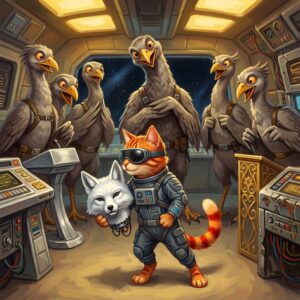
Jordan LeGuin was a cat more than worth his stripes, and he had really beautiful, bright orange and fire-red stripes that only mildly clashed with the more muted tones of his Tri-Galactic Union engineer’s uniform. He’d worked hard to earn that uniform and each of the golden pips on his collar that marked him a lieutenant. He was a naturally smart cat, but that wouldn’t have been enough to make him the chief engineer of the starship Initiative without years of training and studying. For better or worse, Lt. LeGuin was more comfortable reading technical papers and balancing equations than trying to navigate the uncertain waters of most social interactions, so he’d been able to sail far on the sea of intellectual meritocracy.
Lt. LeGuin didn’t know if the fact that he’d been born blind had contributed to his social awkwardness, making him feel different from others — set apart because he experienced the world in a different way — but he was pretty certain that the techno-focal goggles he’d been fitted with as a young kitten had massively accelerated his education beyond the other uplifted kittens and puppies in the school he’d attended in the asteroid belt. By the time he’d made it to the Tri-Galactic Union academy in the terraform bubble of Mars, he was light-years ahead of his age cohort, and he didn’t mind being socially awkward so much anymore.
The data that constantly streamed across his enhanced, assisted vision through the goggles stimulated his mind, grounded him in information about everything surrounding him, and even served as a quasi-companion by providing him constant access to practically every written work ever published up to the minute. If Lt. LeGuin wanted to feel connected to other beings, he had the voices of every great writer, thinker, and artist through all of history and up to the present moment readily available. He never felt alone.
And, of course, in a very real way, Lt. LeGuin rarely was alone. The starship Initiative was filled with other uplifted cats and dogs, not to mention other animal-like aliens who either had joined the Tri-Galactic Union or were simply exchange officers from worlds that were still working out how they wanted to fit into the society that had already been built into the stars all around them. Certainly, they all had private quarters — individuals need their privacy — but it would take more than mere awkwardness to keep anyone truly isolated on such a large, interconnected vessel, and you simply can’t be the chief engineer without interacting with the rest of the engineering staff.
All of that said, Lt. LeGuin had built himself a very safe and cozy comfort zone aboard the Initiative. While working in engineering, LeGuin could safely assume that ninety percent or more of his conversations with fellow officers would be about topics that he really cared about — things he was good at and interested in. And since the other officers in engineering had also selected to follow life and career paths that brought them to a place where they spent most of their time discussing and working on starship mechanics, interplanetary physics, and interstellar propulsion, LeGuin had managed to make some pretty good friends.
When LeGuin wasn’t working in engineering, he could choose between taking his meals and leisure time in the privacy of his quarters or venturing out into more social, shared locations. However, even when he did so, the words and data that streamed across his vision functioned like a shield, allowing him to regulate his own thoughts and feelings inside a kind of imaginary, mental shell that protected him from the buffeting chaos of the thoughts and feelings of the other animals around him. Thus shielded, the timid tabby cat could often enjoy hanging out at the edge of a social group in the Constellation Club or joining in with a few others when they played games in the lumo-bay.
LeGuin’s best friend was Fact, the android arctic fox, and the two of them interacted almost exclusively in engineering. Easily eighty percent of their interactions were centered on their shared work. Even so, the friendship was reciprocal, and the two of them — mechanical being and being who preferred mechanical things to most living beings — took great comfort in each other’s reliable, consistent, predictable presence.
When Fact arrived at his duty shift two minutes late, Lt. LeGuin immediately knew that something was up. Other officers moved around the ship like helium atoms bouncing inside a balloon — erratically and unpredictably — but Fact’s brain was essentially a computer, so zhe moved with an utterly predictable precision that Lt. LeGuin aspired to and was helped toward achieving by the data in his goggles. Even so, an organic tabby cat could never keep up with an actual android when it came to precision, whether he was assisted by techno-focal goggles or not.
“Something delayed you?” the orange tabby distractedly asked his friend while continuing to analyze the charts and graphs that the ship’s computer had compiled of the zephyr drive’s performance over the last few months.
“No,” the arctic fox answered in a gently precise tone. “I decided to explore the truth of the phrase, ‘variety is the spice of life,’ and so I have been making minor variations to my routines to see if it ‘spices’ up my life.”
Lt. LeGuin looked away from the computer panel showing the charts and graphs that had been occupying him. His whiskers turned up in a smile as his friend managed to surprise him into completely ignoring all the rest of the data streaming across his goggles, overlaid over his view of the engineering room. “And what have you found so far?” LeGuin asked, his voice tinged with amusement.
Fact’s triangular white ears splayed minutely to the sides, a barely perceptible display of emotion. “I have not found that any of my alterations to my schedule have made significant differences so far, certainly nothing that warrants an adjectival description like ‘spicy.'”
“Maybe you’re not making the right kind of changes,” Lt. LeGuin suggested.
“That is a definite possibility,” Fact admitted, untroubled by the idea that zhe hadn’t yet discovered the proper way to perform zir experiment. Varying the parameters until zhe settled on the correct factors to discover interesting, worthwhile results was simply part of doing good science.
The orange-striped tabby and android arctic fox fell into a smooth, pleasant rhythm working beside each other, monitoring and maintaining, tweaking and fine-tuning the mechanical systems that kept their spaceship running. Other officers came and went, performing their duties in the engine room as well.
On that particular day, the starship Initiative was surveying the planets in a nine-star system, composed of two small trinary star-systems and a binary star-system locked in a Trojan-type orbit of a super-luminous star. The interacting gravity fields of all those stellar bodies and their effects on the ship’s engines were fascinating. However, this was a stable, unpopulated system, so it was also a relatively straightforward, low-stakes kind of work.
“I’m detecting the signs of another ship in this system,” Fact observed.
“In this system?” Lt. LeGuin asked archly, transferring the readings Fact had on zir screen directly to the data overlay inside his techno-goggles where he could look at them up close.
What the android fox had detected was an ion trail, the kind that would only have been left behind by a damaged spaceship, limping along on its last legs. Well, engines.
The trail was erratic and petered out, but Lt. LeGuin applied a predictive algorithm to the ion trail and was able to continue the path, assuming some basic variables, which showed that the ship which left it should have continued on towards the super-luminous star near the center of this system. In fact, the trail suggested that the ship would be spiraling closer and closer to the star on a decaying orbit. This was not good.
Lt. LeGuin focused several of the ship’s sensors on a more detailed sweep of the arc of space where the damaged ship was most likely to be, and sure enough, pay dirt. There were no signs of engine activity, but there was definitely a lump of metal displaying distressingly flickering signs of life support systems running.
“That was a good catch, Fact,” LeGuin meowed softly. “This ship is dangerously close to the central star. A few more hours, and even if we’d happened to scan that region, signs of this ship would’ve been completely obscured by flares from the solar storm coming down from the star’s pole right now. But as it is…”
“We have time to save it,” Fact announced. “I’ll contact the captain.”
“You do that,” LeGuin agreed. “I’ll keep studying it.”
So while the android arctic fox tapped the comm-pin on zir breast and apprised the bridge crew of the situation, Lt. LeGuin continued refining and analyzing the scans he could get from this distance of the damaged spaceship.
It was a strange sort of ship, composed of a mishmash of different alloys. Different regions of the ship seemed like they’d been built under entirely different technological schemas. Parts of it looked Ursine in design, other parts Morphican, and there were even aspects that seemed Xophidian. Though overall, the ship reminded Lt. LeGuin the most of a Pollengi vessel, almost as if the hull of a Pollengi ship had been retrofitted with pieces of scavenged technology from some space graveyard creating a Frankenstein’s monster of a starship.
Fact interrupted the orange tabby’s peaceful reverie — analyzing the design of a foreign starship was perhaps his favorite of all activities — to say that the captain was currently unavailable, but Commander Wilker had authorized engineering to contact the distressed starship directly and offer their help.
“Wonderful,” Lt. LeGuin meowed distractedly. “Have you looked at the readings I’m getting? This vessel is fascinating. I’d like to get a look at it firsthand and see how they’ve managed to sew all these disparate designs together.”
“What an interesting idea…” Fact replied enigmatically. “I was going to suggest that we send them a simple text-based message offering to tow them into a stable orbit and asking what supplies they’d need to effect repairs on their ship themselves, but perhaps, we should offer to come aboard and help perform the repairs ourselves?”
The white fox tilted zir head inquiringly after finishing zir suggestion.
“What?” LeGuin asked, still mostly focused on trying to understand how the clearly overpowered engines on the damaged ship hadn’t torn its ornate golden hull apart the first time they’d been turned on. “You mean, like, send a couple of our technicians over there to help with the repairs?” The orange tabby’s brow furrowed, crinkling the V of darker stripes between the shiny lenses of his techno-focal goggles.
“I mean,” Fact enunciated ever so clearly, “that you and I should ask Cmdr. Wilker to send the two of us over to the damaged vessel to help with the repairs ourselves. It would certainly be a larger variation in my usual routine than arriving to my duty shift two minutes and thirty-five seconds late.”
Lt. LeGuin’s whiskered face broke into a wide, Cheshire-cat grin, and he couldn’t help laughing. “I suppose I could join you in trying to spice things up a bit.” Turning serious again, the orange tabby added, “Especially if it means getting to check out this bizarre ship myself.”
* * *
The starship Initiative glided easily through the star system, speeding up as it cruised lower and lower relative to the grasping mass of the super-luminous star. Then as it passed close by the damaged spaceship, the Initiative cast out an EM-beam that pulled the two ships together, transferring some of the Initiative’s kinetic energy to the other ship.
The two ships cruised away from the super-luminous star, cutting across different possible orbits until they settled into one at a safe distance from the dangerous solar flares. The Initiative delicately adjusted its course, pulling the damaged ship along, until their shared orbit became stable and vaguely circular, keeping their distance from the star approximately constant.
As soon as the maneuvers were finished, Cmdr. Wilker’s long canine face appeared on the engineering panel screen that Lt. LeGuin had been using. The collie dog barked, “Now tell me again why I’m supposed to send two of my senior-most engineers over to this heap of junk rather than just teleporting some supplies and instructions to the avians aboard it?”
Fact came over to stand beside Lt. LeGuin and addressed the ship’s commander directly to ask, “Is the captain still unavailable?”
Cmdr. Wilker noticeably bristled on the screen. All three of them — collie, orange tabby, and arctic fox — knew that the ship’s sphynx cat captain harbored a certain favoritism for the single android officer aboard ship and would likely give zir whatever zhe asked for with little questioning. However, Captain Jacques wasn’t on the bridge right now, and Cmdr. Wilker liked to keep his flock in order. The collie prioritized the safety of every crew member more highly than whimsical questions of curiosity. While the cat was away, the collie made sure that there wasn’t any sort of uncalled-for play.
“The captain is busy,” Cmdr. Wilker barked grimly. “I’m in charge. Now tell me what’s going on.”
Lt. LeGuin didn’t think the collie dog would be impressed by an appeal having to do with Fact’s desire to seek out variation in zir routine, and the orange tabby’s own desire to see the other ship’s design also wouldn’t particularly speak to the dog’s priorities. “Commander,” the tabby meowed, “this ship is clearly far from home and struggling.”
“I’ll grant that they’re clearly struggling,” Cmdr. Wilker woofed softly, “but being far from home is the purview of every space explorer.”
“True,” Lt. LeGuin agreed easily and amiably, “but nearly dying in a solar storm in an uninhabited system will have taken a massive toll on not only the ship’s systems but also its crew. Do you really want to be responsible for a ship being repaired poorly and the crew finding itself stranded a second time because we didn’t offer every bit of aid we could have? I want to personally oversee that this ship is repaired properly so that the crew can get home safely.”
Cmdr. Wilker’s soft brown eyes narrowed, looking troubled. The collie wanted to keep his own crew together, but there wasn’t a better way to appeal to the dog’s better nature than to invoke the safety of those who might already be in danger. “Very well,” the collie allowed. “But keep it brief and professional. I spoke with the captain of the other ship before towing it to this higher orbit, and he seemed sincerely flustered by their situation… But even so, I want you to be on guard. While this is apparently a Pakkeli ship, and the Tri-Galactic Union has had very few recorded dealings with the Pakkeli, they are closely related to the Pollengi, who have caused us serious trouble in the past.”
Lt. LeGuin didn’t need to be reminded of the time that the chicken-like Pollengi had successfully ambushed and seized control of the starship Initiative. Along with most of the crew, LeGuin had been teleported down to a hostile, barren world to perform heavy labor in a hyper-diamond mine until a small team had managed to win back control of the ship and reverse their fortunes.
“If there’s the slightest trouble,” Lt. LeGuin assured the collie commander, “then Fact and I will call to be teleported back to the Initiative immediately.”
Cmdr. Wilker nodded solemnly and said, “See that you do.”
* * *
Lt. LeGuin and Lt. Fact teleported directly to the other ship’s engine room, along with a carefully arranged pile of equipment and replacement parts that they intended to use for the repairs. The orange cat, white fox, and pile of supplies appeared in a golden haze of quantum energy in a hectic, haphazard space with three of the Pakkeli staring intently at them.
The Pakkeli’s yellow beaks were sharply pointed; their gray-brown feathers alternately sleek and ruffled as they shuffled their talon-feet and shook their wing-arms in a nervous, fidgety way; and their yellow-orange eyes were very, very wide and round, filled with a pointedly inquisitive, vaguely judgmental quality as each of them tilted their heads from one side to the other, almost as if trying to shake some troubling idea out of their minds. They were also quite large for birds, easily taller than both Lt. LeGuin and Fact.
“Bock!” the middle Pakkeli cried out. “You are welcome! Please fix.”
“Yes, please fix, bock!” each of the other two Pakkeli echoed. “Please, please fix!”
The darker orange V of fur above Lt. LeGuin’s techno-focal goggles rose as he listened to these alien birds plead for help. Perhaps they were merely rattled by their recent near-death experience, but right now, their degree of helplessness made him wonder how they’d made it out into space at all… let alone all the way to this distant star-system. Nonetheless, he purred kindly, “That’s what we’re here for — to help.” The cat lifted up the attaché case he was holding, filled with diagnostic and mechanical tools to show he was prepared to do some real work. “Just point me toward the damage, and we’ll see what we can do to patch your ship up and get you back on your way.”
“Oh, good, bock!” the Pakkeli on the left exclaimed chirpily. “Clever mammals will help us fly!” Then with a shuffling hop-step the gray-brown bird scurried through the cluttered engine room, avoiding scattered tools and materials strewn across the floor — many of which looked like broken or used-up engine components that had simply been left lying about when they stopped working — and led the way to a zephyr drive coil that was glowing and pulsing at a much slower rate and duller luminosity than it should have been.
Lt. LeGuin immediately settled into examining the zephyr drive coil, looking for inefficiencies and malfunctioning components as if this strange ship’s engine were an old friend he was catching up with, asking it how it was feeling and listening to its stories of its woes in a language made from schematics and sensory readings.
While the orange tabby worked directly on the drive coil, Lt. Fact began tidying up the area around the coil in a persnickety, fastidious way. As the arctic fox worked through the clutter of broken objects, testing each to see if there was any use left in them, two of the Pakkeli bustled around, getting in zir way and asking simplistic questions.
“Why are you moving everything?” one of the birds asked, its head twisted fully sideways.
“A clean workspace is easier to maintain and improve,” Fact answered easily, rescuing a self-sealing stembolt that still looked functional from the growing pile of refuse zhe was arranging into a tidy stack. “When we’re finished here, it would behoove you to try to keep the area clean.”
There was an archness to the fox’s comment that drew Lt. LeGuin’s attention to the interactions happening around him. Only part of his attention, though, as the orange tabby was absolutely fascinated by the unusual way that the zephyr drive coil had been installed. It was upside down.
Of course, in outer space, there’s negligible gravity, so upside down doesn’t really exist in an absolute sense. However, inside of a modern spaceship, there’s artificial gravity… and it wasn’t at all surprising that the drive coil wasn’t functioning at full capacity while upside down relative to the artificial gravity.
With a little more work, Lt. LeGuin discovered that there had apparently been a bubble of inverse artificial gravity around the zephyr drive coil at some point in the past. He could tell because there were still relays set up to maintain the bubble of contrasting gravity, even though they were no longer functioning.
A bubble of inverse gravity was an ingenious — but also really stupid — solution to a problem that should have been fixed properly. And of course, once the bubble had failed, the coil had stopped working properly. The whole drive coil would have to be shut down, uninstalled, turned right side up, and then reinstalled correctly.
The work would take several hours, and it would require both Fact’s help and enlisting assistance from some of the Pakkeli. A zephyr drive coil is a large piece of equipment, and a single tabby cat wouldn’t be able to remove it and flip it around on his own. At least, not without some fancy localized gravity alterations that would be a lot more work than just asking for help. Even so, Lt. LeGuin found himself fascinated by the idea of trying to do this job the hard way… Partly because he didn’t relish the idea of engaging the Pakkeli in his task, but mostly because it seemed like a fun problem to solve.
Fact had been right: traveling to a different spaceship was spicing up LeGuin’s life. Seeing firsthand the haphazard ways that this drive coil had been mis-installed was fascinating and inspiring all kinds of ideas in his mind about how pockets of inverse — or merely lowered — gravity could be used aboard the Initiative.
Generally, once the artificial gravity is set to a comfortable, uniform level aboard a starship, no one stops to think about how very optional that force really is… and being optional, how very many ways it could be played with or utilized to make some tasks easier or decrease strain on delicate systems. Why, LeGuin could already list off a half-dozen places in the Initiative’s engine room where a small pocket of alternate gravity might increase their own zephyr drive’s engine efficiency. He was sure that he could write up a proposal and get the captain to sign off on him trying some of them out…
But, of course, for now, he needed to focus on fixing the Pakkeli vessel, so the orange tabby turned his attention to the other living creatures in the room, gesturing for Fact and the nearby avian aliens to gather around him while he explained the situation and his plan for dealing with it.
“You are clever, bock!” one of the Pakkeli chirped after LeGuin was done explaining. “Very clever!”
The compliment felt good to the orange tabby, and his whiskers turned upward in a smile. Even so, the compliment began to curdle in his mind as LeGuin found himself worrying about how the Pakkeli were going to properly maintain their engine if they were so easily impressed by him simply realizing that it shouldn’t be upside down.
So, as the orange cat worked with the Pakkeli to fix their engine, he also did the best he could to describe what he was doing at every step, teaching as much as he could along the way, and also to ask questions of the avians, trying to feel out how they’d come to be in this situation. However, his attempts at connection were largely more frustrating than successful. The Pakkeli were happy to assist with simple tasks — such as lifting the drive coil out of its settings once all the fastenings were detached — but their responses to LeGuin’s attempts to teach them about their own engine were met with uncurious flattery.
“The furry mammal is very smart, very smart, bock,” one of them would say, and then the others would join in, turning the compliment into a pretty little chorus of praise, showing no sign of understanding — or really even listening to — the cat’s explanations at all.
When LeGuin brought up the unusual way that some of the ship’s technology seemed to be mismatched in style — working hard to avoid terminology that would be offputtingly technical — the birds simply stared at him with wide, round eyes.
“I’m asking how you came to have a zephyr drive coil that looks like it was built in an entirely different facility than the hull of your ship.” The tip of the orange tabby’s tail twitched irritably behind him.
“It is a good coil, bock!” chirped one of the Pakkeli, feathers ruffling like ripples spreading across a puddle of water.
“And a good hull!” chirped another.
“Yes,” LeGuin agreed, his triangular ears flattening. “They’re very nice components. I simply don’t understand how they came to be together.”
All the Pakkeli in the engine room — there were five of them now, since a couple more pairs of wing-arms had been needed for hoisting the coil back in place — began cooing in an eerie way, almost like chuckling.
“We like good things,” the seeming-leader of the group chirped. “Like you.”
“Yes, yes, bock!” the other Pakkeli agreed in an erratically syncopated chorus. “We like you!”
By this point, the zephyr drive coil was reinstated where it belonged, right side up and ready to be fully fastened in place. All there was left for Lt. LeGuin and Lt. Fact to do was hook the drive coil back up to the rest of the ship again — a task that should be easy for anyone who had been paying proper attention to LeGuin’s explanations of how he’d been unhooking the drive in the first place. Simply reverse the steps.
The orange tabby cat found himself torn — if these birds weren’t capable of finishing the repairs on their own at this point, then they had no business flying around alone in deep space. On the other paw, even if they had no business being out here, that didn’t mean it would be okay to leave them at the mercy of the tides of gravity.
The orange tabby and white fox looked at each other, and they knew each other well enough for each to read in the other’s expression that they were thinking along the same lines. It was time for them to go.
“I’m glad you like me,” Lt. LeGuin meowed, “and if you have any engineering questions in the future, I’d be happy to have them relayed to me on the Initiative, and I can send you answers. However, it’s time for my colleague and me to return to our own ship now.”
“We like your colleague too,” another one of the Pakkeli chirped, drawing a blazor from a holster that had been obscured behind its back. “You are both very nice components, bock, and even if you came from — bock! — an entirely different facility, we think you should roost here now.”
Lt. LeGuin had never heard his own words mirrored back to him by a bird who sprinkled them with seemingly involuntary vocalizations of “bock” before. He wasn’t sure that he’d have liked it in any circumstances, but the cat was especially sure he didn’t like it in these circumstances. Without further discussion, the orange tabby tapped the golden comm-pin on his breast and said, “Initiative, we’re done here. Two to beam back.”
Several beats passed, and nothing changed. No golden quantum energy fizzed through the cat’s body. The Pakkeli engine room didn’t disappear around him, and the Initiative’s teleportation bay didn’t reappear around him.
Lt. LeGuin tapped the comm-pin again, and it made a metallic sputtering sound.
The arctic fox standing beside him said in a frighteningly even, hollow tone: “I believe that the Pakkeli have blocked our communications with the Initiative and blocked the Initiative’s attempts to teleport us out.” Raising zir voice slightly, Fact asked pointedly, “How long ago did you begin blocking our communications? As soon as we arrived? Once you’d decided that we’re valuable to you? Or only after we declared our intent to leave?”
Cooing chuckles erupted from the birds all around them again. Suddenly, it felt quite menacing how large these birds were. “Clever mammals think birds can’t be clever too, don’t they, bock? But birds are clever. Clever enough to keep you here.”
Lt. LeGuin’s ears splayed in irritation, but the cat wasn’t truly worried yet. He knew that his companion and best friend was a literal machine who could move faster than any biological lifeform, and his own techno-focal goggles were streaming data across his vision constantly that gave him a significant advantage over any non-augmented beings. Even if these birds were bigger than the two of them, the augmented cat and fox still had the upper paw.
Then the balance tipped: the clearly readable data filling LeGuin’s vision scrambled, glitched, and flickered out, leaving the orange tabby utterly sightless, completely dependent on his other senses, and a crashing sound next to him was followed by Fact uttering in a desolate voice, “I can’t move. Every part of my body has locked up below my neck… please… help me up?”
Now LeGuin was worried. More than that, he was genuinely scared.
Fumbling with his paws, the blind orange tabby knelt down, groping the air around him until he felt the gentle curve of Fact’s narrow back. He recognized the mix of firmness and plush caused by the android’s thick white fur under zir uniform. Also, the coolness — most animals with fur as thick as Fact’s would be warm to the touch, but the android didn’t have to maintain an endothermic body temperature like actual mammals. Based on zir position, LeGuin judged that the android must have fallen face-forward to the floor.
“My paw is on your back,” LeGuin meowed. “Can you feel it? Are you okay?” Then raising his voice from the gentle tone aimed at his friend to a strident, angry, frightened tone, the cat called out to all the avians who he knew must still be standing around them, “What’s wrong with you? Why would you do this to people who are here to help you?”
The birds didn’t answer, but Fact said, “I cannot feel anything below my face. Are your techno-focal goggles still working?”
“No,” LeGuin meowed in dismay. He already desperately missed the wide array of facts that his goggles should have been sharing with him — temperature readouts, airflow diagrams, EM-maps, and even cute little quotes and factoids displayed along the bottom of his vision at regular intervals to amuse and inform him. He almost missed all that meta-data more than the mere vision itself. Even if he couldn’t see the room around him, if his goggles had been working well enough to provide him with all the overlay data they usually offered, he’d still have been able to function fairly normally. As it was, the orange tabby felt completely lost.
“To disable my body and your goggles so swiftly,” Fact said primly, “they must have used a localized EM-blast.” Raising zir voice, the paralyzed arctic fox asked the birds who must still be hovering around them, “Was it luck that you took out my friend’s goggles and my own body with one blow? Or was that carefully calculated to disable us as much as possible without actually inflicting permanent damage?”
Cooing laughter broke out all around. The Pakkeli were clearly pleased with themselves. Privately in his own mind, Lt. LeGuin couldn’t help feeling that they deserved to feel that way — these birds had successfully suckered two of the Initiative’s top officers into devoting hours to helping them and then taken them captive in a single blow.
So much for spice. This adventure had turned into heartburn and regret.
“Not feeling so clever now, bock?” an avian voice asked mockingly. “You can feel clever the next time our engine needs maintenance. For now, bock, you can get used to living in your new nest.”
Rough feathery hands grabbed Lt. LeGuin by each of his arms and yanked him up, away from Fact.
“What’s happening?” LeGuin meowed. The birds didn’t answer him, but paying close attention to the movement of air through his whiskers, the orange tabby was pretty sure that they were picking Fact up from the floor too. His theory was confirmed when one of the birds complained strenuously about how heavy the android was. The cat wanted to mock the bird about how that wouldn’t be the case if they hadn’t disabled the fox… but… he kept his sharp tongue behind his sharp teeth, knowing it was better not to antagonize a ship-full of hostile avians who currently had him and Fact at a significant disadvantage.
He needed to wait until the two of them could find a way to get their advantages back, or else, find some new advantages.
* * *
The Pakkeli locked Lt. LeGuin and Lt. Fact in a room together that was filled with the bright, musty smell of fresh hay. A smell that LeGuin recognized from when he was a kitten back on Earth and had visited a farm with hay bale castles and corn mazes every fall. The sense memory was a cheerful one and contrasted strangely with being imprisoned on an alien ship in deep space.
Without his goggles working, the orange tabby was forced to feel his way around with his paws, combined with listening to Fact’s description of what zhe could see. Though, at first, all the android could see was the room’s nondescript ceiling. Once LeGuin was able to get Fact propped up in a sitting position, leaned against a wall, the android was able to give a more useful description of their surroundings.
“There are two doors,” Fact said, “the one I was carried through and another one on a side wall; the only furniture is a pair of wireframe structures filled with some sort of dried plant matter–”
“Hay,” LeGuin meowed, blankly.
“–yes, quite possibly hay, that turns them into cozy-looking nests.”
The orange tabby sniffed dismissively at the idea of anything in this prison being cozy.
“And perhaps most pertinently,” Fact continued, ignoring zir friend’s bleak attitude, “there seems to be a synthesizer alcove embedded in the back wall.”
“Really?!” LeGuin hopped back up to his feet from where he’d been kneeling beside his incapacitated friend. “Which direction?”
“Turn one hundred degrees to your right,” Fact said, and the tabby immediately followed zir directions. “Now walk forward one point three meters.” Again, LeGuin complied.
The orange tabby could feel the presence of the wall in front of him by how it interfered in the airflow through his whiskers. He reached out a paw and was able to find the indentation in the wall where the synthesizer was situated — an alcove where synthesized objects would render and a control panel beside it for designing the desired objects.
“Why would they give us this?” LeGuin asked.
Fact suggested, “Perhaps its controls are locked such that it can only synthesize food and other simple necessities.”
“Hmm,” LeGuin mused. “Most likely. What about the second door you mentioned — can you guide me to that?”
“Most certainly.” The incapacitated android once again gave zir friend directions for walking through the room to where he was able to put his paws against the second door.
LeGuin fumbled with his paws until he found the controls on the wall beside it. The door slid open easily enough, but all that proved to be behind it was a simple washroom. So, they had access to water and other hygienic necessities, but nothing that would help break them out of their confinement or put them back in contact with the Initiative. At least, not without some seriously clever jury-rigging.
The orange tabby found his way back across the room and slid down to sit on the floor, leaned against the wall beside his incapacitated friend. Despondently, Lt. LeGuin meowed, “How long do you think it will take the Initiative to rescue us?”
“That depends on a number of factors,” the android fox answered, zir tone remarkably normal considering zir situation. “Would you like me to enumerate the most likely factors or simply offer a rough estimate?”
“Rough estimate, please,” LeGuin said, a touch of amusement entering his voice in spite of himself.
Even if Fact was immobilized from the shoulders down, there wasn’t anyone Lt. LeGuin would rather be kidnapped and incarcerated with.
“I would guess that the starship Initiative under Cmdr. Wilker’s command will surmise our situation and figure out a way to rescue us somewhere in the range of several minutes from now to several hours from now.”
“That’s not so bad,” LeGuin meowed, desperately wishing that his goggles were working so that he could run his own calculations on them. He really did miss the computational aspects they provided more than the mere sight. “Maybe we should just wait it out. You know, find a way to pass the time and trust our crewmates.”
“Perhaps,” Fact allowed. “However, we came here seeking variety, and what we’re facing right now is actually a fascinating puzzle: how can we rescue ourselves and escape from this situation, given the limited supplies we have at paw?”
“Huh, like an escape room.” Lt. LeGuin allowed the tip of his long tail to tap out a silent rhythm on the cold metal floor.
“An escape room?” Fact asked, zir voice gently rising at the end in a way that implied zhe would have tilted zir head to the side quizzically if zhe still had motor control over the muscles necessary to do so.
“Yeah,” Lt. LeGuin said, “they were a popular form of entertainment for a while back on Earth. Rooms filled with puzzles that you had to solve in order to get out of them and an arbitrary time limit imposed in order to raise the stakes.”
“Intriguing,” Fact said. “What happened if you didn’t solve the puzzles before time ran out?”
“Nothing,” LeGuin meowed. “You simply didn’t win.”
“I think our stakes are a little higher than that,” Fact admonished. “But yes, let’s think of this like an escape room and see if we can’t rescue ourselves before Cmdr. Wilker manages to.”
Lt. LeGuin’s whiskers lifted in a genuine smile. “A race with the Collie commander, you say? Oh, it is on. He’s a good dog, but even with a full ship and crew at his disposal, I think a clever cat and fox like us can beat him. Now, how shall we begin?”
The cat and fox discussed their possible assets and avenues of attack — both of which were quite limited — and eventually settled on beginning with Lt. LeGuin trying to hack the synthesizer. He had to work by touch. Fortunately, the cat was extremely familiar with the wiring of synthesizers. When he reached a point where it was truly necessary to tell the different wires apart by sight, Fact volunteered to be his eyes. So, LeGuin disconnected Fact’s head from zir body and propped it up inside the synthesizer alcove where the fox could see what the cat’s paws were doing.
Fact told LeGuin the colors of different wires and the identifying labels inscribed in the mechanism as the clever feline rewired the synthesizer, trying to bypass its limitations and reverse its data-feed from the ship’s main computers.
“You know,” LeGuin grumbled as he worked, using only the very tips of his retractable claws to do the fine, detailed work, “the nice thing about actual escape rooms is that you know they have a solution. For all we know, what we’re trying to do here could actually be impossible.”
“For what it’s worth,” the disembodied fox head said amiably, “since Cmdr. Wilker is completely unaware of our race against him, he will be unable to boast about it if he wins. Only we will know.”
“That almost makes it worse,” LeGuin muttered under his whiskers. However, as he spoke, the last bit of wiring twisted into place. “Did it work? It feels like it worked.” His tail lashed in anticipation as he waited for the android’s confirmation. LeGuin wished he could see the synthesizer’s display without relying on his friend to describe it.
“Yes,” Fact confirmed. “The synthesizer’s display is now scrolling through a wide array of data that it should not have access to. I believe it will now be possible to access the ship’s communications systems and send a clandestine message to the Initiative about our predicament, in case they haven’t figured it out for themselves yet.”
“Yeah, that’s one thing we can do…” Lt. LeGuin meowed in a leading tone. “But I have another idea for something to try.” The orange tabby pulled one of the thicker wires he’d been working with out of the exposed panel and drew it up to the side of his techno-focal goggles where they rested against his temple, under his triangular left ear. “That directed EM-pulse may have knocked out my goggles, but the neural interface they hook into is more heavily shielded.”
“As one would hope for a device implanted directly into your skull,” Fact commented drily. “However, wouldn’t it be safer to hook the computer system up to me?”
LeGuin shook his head, a gesture that felt more immersive without the visual data his goggles would have usually provided. “We don’t know the full extent of the damage done by the EM-pulse. There’s a chance that hooking you up to an external system could short your head out entirely and leave me alone here. Whereas, if my neural interface has been damaged, it’ll simply fail to work at all. No harm, no foul.”
“I would nod in agreement with your measured assessment of the situation, if I could,” Fact replied. “Since I cannot, let me just say, good luck and let me know if it works.”
As soon as Lt. LeGuin completed the hookup, data began streaming through his mind in a chaotic jumble. If his goggles had been working, they would have interpreted the data and shunted it into folders and directories, all of which would have been made accessible in an orderly manner through the visual interface they provided. Instead, the cat found his mind wandering as if through a daydream, flooded with abstract imagery — shapes and connections, lists of numbers, timers arranged to go off at erratic intervals, and layers upon layers of windows and tabs all of which jumped out at him from every which direction, even some directions that only existed in his imagination. It was as if a computer interface and a daydream had been mixed together in a blender, and the resulting margarita of data had been poured directly into the orange tabby’s skull.
Eventually, a familiar voice reached him in the jumble of information:
“You’ve been quiet for an unusually long time,” Fact said gently. “If I had my paws available, I would try to disconnect you from that interface at this point. However, my paws are still over there on the floor with the rest of my body, and until we repair the damage from that EM-pulse I wouldn’t be able to move them anyway. Please be okay, my friend.”
With a force of effort, Lt. LeGuin found his voice and said, “I’m okay, Fact. I just… I have to think for a while.”
After several minutes of letting his mind float aimlessly through the vectors and matrices of raw data, Lt. LeGuin began to feel an awareness of his own body returning — starting with the irritably impatient twitching of the tip of his tail. Then he noticed that his ears had skewed to the sides. Finally, he realized that both of his front paws were gripping hard onto the edge of the synthesizer’s alcove, as if it were the side of a boat, and if he let go, he might sink into an ocean of abstract data forever.
“I think I’m starting to get the hang of this,” LeGuin meowed.
“I’m glad to hear that,” Fact said, “because I was beginning to wonder if your original plan — waiting for Cmdr. Wilker to save us — might have been the right course of action after all.”
“Never,” Lt. LeGuin spat. “Besides…”
The tabby cat’s words trailed off disconcertingly as his focus fell back into the abyss of data. Except, the more he felt out the edges of the data available to him, the more Lt. LeGuin realized that this wasn’t an ocean of data. It was merely a pond. The computer for a ship like this one should have been far busier and more complicated than what Lt. LeGuin was perceiving.
“I don’t think we’ve hooked into the ship’s actual computer,” LeGuin meowed. “Or at least… not the ship’s main computer.”
“It has multiple separate computer systems?” Fact asked, intrigued.
“At least two,” LeGuin answered, “because there’s no way that this computer is handling the ship’s full operations right now. In fact, it’s mostly dormant.”
“Why would they have a dormant computer system?” Fact asked.
“Why would they have their zephyr drive coil upside down?” LeGuin countered. “Now that I’m interfaced with this computer system, I’m managing to pull up registry data for a lot of the ship’s systems, and they’re not just weirdly mismatched — most of them have had their identification codes actively expunged. They’re clearly stolen. Almost every part of this ship has been stolen.”
“Like us,” Fact pointed out.
“The Pakkeli are thieves, and it’s time to use their ill-gotten spoils against them.”
“Like us,” Fact repeated, a smug little smile twisting zir narrow muzzle at zir own wordplay. “What do you have in mind?”
“A whole lot of data,” LeGuin replied. “But as for a plan, I’m going to start by buffing up all the systems I have access to through this computer that the Pakkeli have been ignoring. You know, just work out the kinks they’ve thrown into the works by installing everything improperly and gain as much power as possible…”
“Are you sure that’s a good plan?” Fact asked with an open curiosity, combined with a slightly troubled hint of judgment. “Just to be clear, your plan is to start by improving the quality of the ship that’s holding us captive?”
“Well…” Lt. LeGuin hedged, only paying a part of his attention to his friend’s objection. “I guess when you put it that way…”
Most of the cat’s mind was very busy in an abstract computer space, fixing any problem he could find in the connections between different systems and the installation of the software that would run various parts of the ship. It was easy to forget about the physical world and the real problems that he and Fact were facing there while his mind could slide from one easily fixed problem to the next, smoothing out errors in a way that he found eminently soothing.
“Aren’t you worried that the Pakkeli will notice what you’re up to?” Fact pressed.
“Those birds?” Lt. LeGuin meowed, laughter tinging his voice.
“They’ve already proved more clever than we expected…” Fact pointed out.
“They didn’t notice their zephyr coil was upside down,” LeGuin countered. He really didn’t want to stop fixing things. It was addictive, like popping bubble wrap. “Besides, everything I’m doing here just makes the systems I have access to and control over more powerful. I’m making us more powerful, not them.”
Before the fox and cat could argue any further, a chiming sound followed by a whooshing sound signified the door opening to their small prison. The musty smell of feathers reached LeGuin’s nose, and then an avian voice rang out, asking, “What is this? What is this, bock? The cat has taken off the fox’s head?!?”
“You bet I did,” LeGuin meowed without hesitation. “You took my eyes away when you hit us with that EM-pulse that broke my goggles, so I needed to borrow another set.”
“Savage,” the avian squawked breathlessly.
Hearing the tone of awe in the bird’s voice, Lt. LeGuin realized he might have an opportunity here. So he added, “Yeah, and besides, this foolish fox didn’t think I should be making improvements to your ship, since you imprisoned us. But I told zir that the way you captured us shows you’re more powerful than our old ship.”
“Powerful, bock!” the Pakkeli echoed, sounding pleased.
“That’s right,” Lt. LeGuin meowed. His whiskers turned up in a grin, hearing in the avian’s voice how much his flattery was working. “I mean, with just a little tweaking to your weaponry, we could even steal the Initiative’s… uh… Ultra Mega Cannon, and then there wouldn’t be a ship out there that could stop us!” For a moment, LeGuin considered adding a “bock” to the end of his little speech, but he decided that might be pushing it and was too likely to accurately come across as mockery.
However, it didn’t take long for the bird to offer an exclamation of its own in that flavor: “Bock! I must take you to the captain! She already wanted to see you about the unauthorized, bock, computer activity from your quarters, but now she will be extra pleased!”
Lt. LeGuin reluctantly detached his neural implant from the computer system he’d been fixing up, and then he reached out gently and grabbed Fact’s head from where it had been resting in the synthesizer alcove. The cat nestled the fox’s detached head against his side, cradled in his left arm. In a derisive tone, he meowed, “See? I told you the Pakkeli were smarter than the dumb dog we’ve been working for! I’m going to drag your head along and make you help me until you understand just how much better!”
“Better! Bock!” the avian exclaimed happily.
* * *
Lt. LeGuin listened closely to the avian’s clacking footsteps. The click of the Pakkeli’s talons on the metal floor proved easy enough for him to follow through the halls of the ship until Lt. LeGuin’s whiskers felt the openness in the air of a wider room. “Is this the bridge?” he asked. “Is my new captain here?”
“I am the captain, bock!” squawked a voice from near the middle of the wider room.
Drawing on all the theatricality he could manage, Lt. LeGuin dropped to one knee, bowed his head, and meowed, “Oh, wise and clever captain of the Pakkeli, I have been trapped on that other ship for too long. The leader there is a weak and foolish dog who never appreciated my talents. I want only to serve on the most powerful ship in the galaxy, and having been captured by your brave crew and examined the wide range of amazing devices that you’ve collected on this ship, I believe there could be no greater ship than this one.”
Under Lt. LeGuin’s arm, Fact’s head made a quiet huffing sound, as if zhe could hardly believe the nonsense zir friend was spouting. However, the arctic fox held zir tongue, waiting to see if the tabby’s gambit would work.
Quiet clucking and cooing sounds emanated from the place where Lt. LeGuin knew the captain was standing. It sounded like the bird had been overwhelmed by the cat’s flattery and was taking a moment to preen her feathers.
Before the quiet clucking could go on for too long, the bird who had escorted Lt. LeGuin to the bridge squawked, “The cat says his old ship had an Ultra Mega Cannon, bock!”
An uproar of cooing and clucking, repeating the words, “Ultra Mega Cannon” and “bock!”, erupted all around, filling the bridge with a cacophony of avian excitement.
Deciding it was time to press his luck as far as he could, the emboldened tabby meowed, “Of course, we’ll never be the most powerful ship in the three galaxies if we don’t steal the Initiative’s Ultra Mega Cannon, but if you let me hook up my neural link to your ship’s main computer, then I can configure your weapons to bypass the Initiative’s shielding, leaving them helpless to our attacks.” The orange tabby allowed a touch of a growl to enter his voice, making him sound fierce and determined like a trapped tiger seeking revenge. The decapitated head of his arctic fox friend, looking aghast, tucked under Lt. LeGuin’s arm only added to the small cat’s fearsome appearance.
“Get that fuzzy mammal, bock, hooked up to the main computer!” the captain squawked, and within moments, Lt. LeGuin felt feathery hands on his shoulders and pressing against his back, guiding him toward the closest, convenient computer station.
This time, Lt. LeGuin and Fact didn’t have to play their complicated game of the cat handling the wires while the fox described them. Instead, more of the feathered hands offered an appropriate cord right into Lt. LeGuin’s paws while other feathered hands helped him to seat himself in a chair and set down Fact’s head on a console beside him.
All in all, it was a far more comfortable setup than he’d had in the quarters that had served as their brief prison, and as soon as the cord clicked into place with his neural connector, the cat’s mind flooded with even more information, systems, numbers, algorithms, arrays, processes, and all of those fun digital goodies that had composed the ocean of abstract data he’d had to learn to swim through before.
In spite of the situation, Lt. LeGuin was having fun. Plugging his brain directly into the first computer had been overwhelming, but this time, the feline knew what to expect and was prepared. It was the difference between splashing, sputtering, and nearly drowning… and swimming a complicated but carefully rehearsed underwater aerobics routine. Within a matter of moments, the orange tabby had already sent a slyly disguised message to the Initiative tipping Cmdr. Wilker off to his plan; reconfigured most of the computer consoles on the bridge so that they couldn’t do anything without running it past him first; and most importantly, rewritten the code that had allowed some previous, misguided engineer to create a bubble of inverse gravity around the zephyr drive coil.
Unfortunately, Lt. LeGuin couldn’t simply drop the Pakkeli ship’s shields himself, because all of the most important protocols — like shields and weaponry — were keyed to specific Pakkeli officers’ bio-signatures. However, he did have direct control over an impressive array of other systems, and he had a plan. Just as long as Cmdr. Wilker received the covert message and played his part properly, the cat expected to be home on the Initiative in a matter of minutes. He’d all but won this escape room.
Right on time, Lt. LeGuin heard an avian voice inform the Pakkeli captain that they were being hailed by the Initiative, and moments later, Cmdr. Wilker’s voice barked, “You’d better have a damned good explanation for what’s going on over there!”
“What do you think is going on over here?” twittered the Pakkeli captain coyly.
“Based on the readings we’re picking up, I think that goddamn orange-striped demon has turned traitor and started outfitting your ship’s weaponry with top secret, classified algorithms that are exclusively known to the Tri-Galactic Union!” The barking voice lowered to a bitter woof and added ruefully, “I should’ve known better than trust a goddamned cat.”
Birds twittered amusedly all around the bridge, sounding quite pleased with themselves.
Lt. LeGuin did his best to hide his smile. Even without being able to see the collie commander, LeGuin could perfectly picture the look of aghast outrage that must have graced the dog’s wolfish face. He had to give Cmdr. Wilker this — that dog knew how to play along with a ruse.
“Are the algorithms ready?” the captain asked.
“Yes, they are,” Lt. LeGuin meowed. “But you don’t have to take my word for it. Go ahead and fire on the Initiative with everything we’ve got.”
“All weapons fire!” the Pakkeli captain squawked gleefully.
Suddenly, Lt. LeGuin’s mind was filled with requests popping up from various bridge consoles trying to fire weapons, but he was prepared and rerouted each and every one of them to firing harmless but visually spectacular particle beams instead of actual weaponry. Knowing that the particle beams would put on quite a show as they hit the Initiative’s shields, Lt. LeGuin tapped into the ship’s viewscreen and took a peek at the fireworks: bright red, purple, and blue beams lit up the vacuum between the two ships and burst into glittering fields of sparkling rainbows as they dissipated innocuously against the Initiative’s invisible force bubble of shielding. It was beautiful.
“Is it working?” the Pakkeli captain asked, sounding puzzled. Clearly, she was clever enough to understand that the Initiative’s shields looked like they were holding up to their attacks.
“That dog lied to me!” Lt. LeGuin yowled with as much fake outrage as he could muster. “He swore the algorithms he gave me were the real ones!” Turning toward the part of the bridge that — based on the sounds he’d been hearing — hosted the main viewscreen, Lt. LeGuin added with a fierce growl, “You never trusted me at all, did you, you… you… stupid canine!”
It wasn’t the most compelling insult LeGuin could have used, but his brain was doing a lot right at that moment and coming up with clever insults wasn’t the cat’s highest priority. The trickiest part of the whole charade was coming up, and it all depended on Lt. LeGuin staying focused and in control.
“It’s time to teach all of you a lesson,” Cmdr. Wilker barked on the viewscreen. The collie’s voice shifted to a quieter but deadly cold tone as he woofed, “Lt. O’Neill, fire the Ultra Mega Cannon.”
Lt. LeGuin had switched off his perception of the viewscreen so he could focus better, but he could still imagine Lt. O’Neill struggling to keep his bearded face straight through all these theatrics. The white highland terrier was also a brilliant engineer, but he consistently lost every poker game he joined with the upper officers. The dog couldn’t bluff. Fortunately, all he had to do to follow the plan Lt. LeGuin had sent them was woof, “Aye, Cmdr. Wilker!” and fire a similarly harmless ray of colorful ions toward the Pakkeli vessel.
Carefully timing his actions with the pulses of ion beams coming from the Initiative, Lt. LeGuin centered tiny pockets of inverse gravity on every avian life sign aboard the ship — too small to actually flip the birds upside down but plenty large enough to make each of their stomachs perform backflips like they were star gymnasts going for gold.
All of the Pakkeli began groaning and moaning, miserable and unsure of why. At the same time, Lt. LeGuin caused the lights to dim and flicker ominously, just for good measure and to help really sell his ploy.
“Make it stop, bock!” screeched the Pakkeli captain. “Stop, stop, make it bock!”
The ship’s sensors informed Lt. LeGuin that the beams of ions from the Initiative had halted, so he similarly halted his activities, allowing the lights to return to full brightness and the Pakkeli’s stomachs to return to normal gravity. Slowly, the moaning and groaning cries from around the bridge halted as well and the ruffled avians began cooing and clucking in tentative, uncertain ways as their stomachs settled.
“That was the lowest setting,” Cmdr. Wilker barked. “Do you want to try a higher one, or are you ready to lower your shields and return the traitors to me for their punishment?”
“Take them! Take them!” the Pakkeli captain squawked without hesitation. “We will not, bock, cross you again!”
Lt. LeGuin received a ping letting him know that one of the Pakkeli bridge officers was trying to drop the shields — exactly the message he’d been waiting and hoping for. However, before allowing the ship’s computer to comply with the request, the orange tabby checked the ship’s position and velocity, assuring himself that it was in a safe, stable orbit, and then — as a final act of sabotage — he rewired the controls to all of the bridge consoles instead to the synthesizer in the quarters where he and Fact had briefly been held prisoner. It would take the Pakkeli a while to figure out what he’d done, but it would do the birds no long-term damage. In fact, the cat even added a timer to his prank so that it would undo itself after ten days — an amount of time that would allow the Pakkeli to really think about the choices they’d made today — in case they really weren’t clever enough to solve his little puzzle.
Fact’s voice spoke out from where it was set on the console beside LeGuin, saying, “Cmdr. Wilker, when you teleport us back, please make sure to collect both my head and my body.”
“You’ve got it, Fact,” Cmdr. Wilker woofed. “Lt. O’Neill, teleport Fact and that orange scoundrel directly to the bridge so that I can deal with them right away. And as for all of you Pakkeli — you should be ashamed of yourselves. I hope you’ve learned a lesson.”
Lt. LeGuin unplugged the cord between his neural connector and the ship’s computer, and just as the golden quantum energy of a teleportation beam began shivering its way through his body, he heard one of the Pakkeli squawk, “That Ultra Mega Cannon blast incapacitated my console, bock! Who’s going to help me fix it?!?”
“Not I,” said the cat as he disappeared in a puff of quantum sparkles.
* * *
“Welcome home,” Cmdr. Wilker woofed wryly to his wayward officers as they appeared on the bridge in a champagne-colored shimmer. “I sent you away in perfect condition, and you’ve returned to me in pieces.” The collie knelt down to pick up the Arctic fox’s disembodied head from where it was lying on the floor.
Held in the collie’s paws, Fact said, “Yes, we had quite an adventure.”
“You’ll have to tell me about it,” Cmdr. Wilker woofed to the head he was holding. Then looking over at Lt. LeGuin who was now sitting on the floor by Fact’s body, fiddling with his techno-focal goggles, the dog added, “Seriously, that’s an order.”
“They turned on us and took us prisoner, sir,” Lt. LeGuin meowed, still fiddling with his goggles. If he could just get them to reset, then they should be able to redownload their software from the ship’s computer, now that they were back onboard. “As soon as we finished our repairs, the Pakkeli disabled Fact’s body and my goggles. They’ve stolen most of the components of their ship, and they told us they intended to keep us as well, locked up in a stripped-down set of quarters.”
“But you escaped somehow,” Cmdr. Wilker filled in, bringing Fact’s head over to zir body. “And you convinced the Pakkeli captain to give you sufficient control over his ship to pull off that little play you scripted for us…”
“Yes,” Fact stated simply. “And we did it before you even knew that anything had gone wrong.”
Lt. LeGuin’s techno-focal goggles booted back up and started filling his vision with data-augmented visuals just in time to see the disembodied head of his arctic fox friend wink at him.
“Here, let me help you with that,” the orange tabby meowed, coming over to take possession of Fact’s head. He was far and away the most qualified officer aboard the ship to get Fact’s body back online, and the collie commander didn’t hesitate about turning over Fact’s head to him.
Lt. O’Neill came over from his position at the front of the bridge to help, and the orange tabby working with the white terrier had their android friend back in one piece and fully functional again in no time. The collie commander grilled both the cat and fox for a while about every aspect of their mission before allowing them to take the rest of the day off from their duties.
As Lt. LeGuin and Fact walked away from the bridge, the orange tabby observed, “I think we got a little more variety in our lives today than we were really looking for.”
“Indeed,” Fact agreed. “And I do believe we got a high score on our escape room.”
The orange tabby laughed. “Yeah, I don’t suppose anyone else will be competing with us to do better — at least, I hope not! However, I do think that, maybe, next time either of us is looking for variety, we should consider some options that are more controlled… you know, safer? Like maybe just running a vintage escape room program in the lumo-bay.”
“That could prove to be an amusing diversion,” Fact said. “However, it seems perhaps overly safe. Another possibility,” zhe pointed out, “is the engineering conference on Starbase 17 next month.”
“Yeah…” the orange tabby meowed distractedly as information about the conference streamed across his goggles, allowing him to put together a tentative schedule of talks and demonstrations to attend. There was both more variety and more control available at the conference than could be found volunteering to repair rogue ships like the Pakkeli’s. With a smile, the orange cat concluded, “Yeah, that sounds much more like our speed.”
“Good,” Fact said. “I’ll sign us up for it.”
 Read more from Techno-Tabby Engineer:
[Next]