
by Mary E. Lowd
Originally published in Red Setter Medic, May 2026
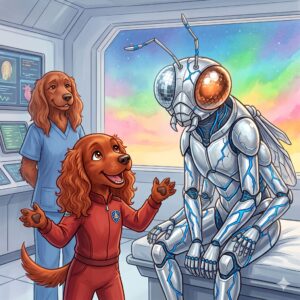
Most of the dogs and cats who crewed the starship Initiative spoke very fondly of away missions. They liked getting their paws on the solid surfaces of real planets or asteroids, feeling fresh air in their whiskers, and enjoying the view of an unobscured sky. Doctor Waverly Keller heard them speak with excitement about visiting strange new places on their missions, meeting weird new kinds of animals, and just basically broadening their horizons.
The red setter doctor, though, didn’t feel the same way. Sure, she enjoyed taking shore leave to a beautiful world for her vacation as much as the next canine, but she did not look forward to away missions. As the ship’s chief medical officer, Dr. Keller was rarely called on to join an away mission if it didn’t involve assessing casualties or providing emergency resuscitations.
Today’s mission was no exception.
Certainly, the sky on Altrus 98 was a beautiful watercolor of rainbow hues, melting from golden-pink sunset tones all the way to vibrant shades of green and blue. But that mostly meant the atmosphere was too toxic to be breathed for very long, decreasing the chance of any survivors. And the stark, rocky landscape with its monument-like towers of stone was stunning, but those towers only existed because of the harsh, ceaseless wind, carving away at every exposed surface like a knife.
This was a terrible place for a ship to have crash-landed. As a kind-hearted dog, Dr. Keller desperately hoped for survivors… but she also feared for them. Due to a recent ion storm that had swept across the quadrant, interfering with communication systems and zephyr drives, several ships had crashed here in the last month, caught in the interstellar currents before they’d settled down enough to send a rescue mission.
One ship after another proved devoid of life, and Dr. Keller’s heart sank. Her long, curly, red-furred ears never stood up tall like many of the other officers’, but the tightness of her muzzle and the creased fur on her brow showed the bleakness of her feelings nearly as well as any flattened ears could.
“There’s only one ship left on our scan,” Commander Bill Wilker woofed. The collie’s expression was equally bleak. “Shall we teleport there?” He wanted to get this mission done with. He’d given up hope on finding anyone.
Dr. Keller couldn’t blame him. She nodded grimly, and he tapped the comm-pin on his uniform’s breast, asking for them to be teleported from this wreck to the next.
Golden quantum energy fizzed through the two dogs, and their surroundings shifted. They’d been standing beside the ruins of a Tri-Galactic Union vessel, and now they were faced with an entirely different kind of crashed ship: one composed of triangles and hexagons. They’d seen this kind of ship before.
“Oh, no,” Cmdr. Wilker woofed. “Not this again.”
The last time one of Cmdr. Wilker’s away missions had found a crashed Archidopteran vessel, it had presaged an all-out attack from the arthropoidal aliens. These insects were profoundly hostile, and most members of the Tri-Galactic Union hoped to never hear another whisper of their presence in the three galaxies again.
“We should still check for survivors,” Dr. Keller woofed through gritted teeth. She didn’t like the idea of dealing with Archidopterans again — last time, she’d spent three weeks untangling the mush that the catalytic enzymes from one of the insects’ cocoons had made of three of the ship’s officers, including the sphynx cat captain. She hadn’t been at all sure that she’d be able to save their lives, let alone extract the three beings from each other and allow them to return to their separate lives.
But Dr. Keller had sworn an oath to save lives, and if there were any survivors aboard this crashed ship, then she couldn’t look the other way. She had a duty to rescue them.
“Fine,” Cmdr. Wilker woofed. “But stay behind me.” The collie drew his blazor and turned it up to the highest setting. He wasn’t taking any chances.
Cmdr. Wilker was about the same height as Dr. Keller, but he was built a lot sturdier under his thick collie mane and had a lot more combat training. He led the way into the broken Archidopteran vessel, keeping his blazor in front of him. Dr. Keller followed in his shadow; she kept her own blazor holstered and focused on the readings displayed on the screen of her uni-meter.
Usually, the Initiative could have scanned for life signs of survivors from orbit, but residual ionic interference from the recent storm meant that truly reliable readings required getting up close to the wreckage. Dr. Keller didn’t want to risk missing anyone… even an Archidopteran. Though, deep in her heart, she felt conflicted — for the first time, she wasn’t really hoping to find survivors. She didn’t want to save the life of a hostile insect whose race had tried to obliterate her own.
The two dogs moved from one room to the next of the silent vessel, passing one lifeless insectile body after another — each of their silvery carapaces gleaming in the light that shone from the underside of Cmdr. Wilker’s blazor. Their many-jointed limbs were broken, exoskeletons cracked, and faceted eyes dim. They’d all been hopelessly, fatally mangled by the crash.
“I think we’re almost done here,” the collie woofed, staring at one of the piles of silver armoring that had once been a living Archidopteran. “But we’ll have to send an engineering team down to extract any information we can from the computers.” There was a hollowness in his voice. The collie didn’t want to learn that the Archidopterans were planning to attack again.
Dr. Keller was about to re-holster her uni-meter and agree to teleport back to the ship when a faint green light appeared on the display. A life sign. Weak. Flickering. But definitely present.
The red setter held her breath for a moment, waiting to see if the life sign would flicker out, relieving her of her sworn duty, but she couldn’t wait longer than that. One breath. That was all she was willing to allow herself, and when it was over, the life sign was still there.
“Someone is alive aboard this vessel,” Dr. Keller woofed, so softly that she almost didn’t expect Cmdr. Wilker to hear her. But the vessel was silent other than for them, and so her whispered words echoed.
“Other than us?” the collie asked with surprise.
“Maybe it’s a prisoner,” Dr. Keller suggested, finding hope in that idea. “Someone they captured and tried to convert with their cocoons — maybe it’s someone I can save.”
The collie nodded sagely. He couldn’t argue with that idea. Anyone who’d been captured by the Archidopterans and wrapped in one of their catalytic cocoons would be in desperate need of a doctor. “Let’s find them,” he woofed.
Dr. Keller pointed the way, and Cmdr. Wilker proceeded, still wielding his blazor. The two canines moved quickly, not wanting to spend any extra time in this Archidopteran graveyard. The life sign readings on Dr. Keller’s uni-meter grew stronger as they approached a room in the back of the ship. Cmdr. Wilker had to cut through several closed doors with his blazor, but eventually they arrived in a room with several cracked stasis chambers, containing insectile corpses. Though, these dead Archidopterans were different than the others they’d passed.
Most of the Archidopterans who’d died on this ship seemed to have been about the same height as the two dogs, but the ones in this room were noticeably taller. Though, their arms — six each — were more delicate, and the translucent wings sprouting from their backs — crumpled in most cases — were substantially larger.
“This looks like a different caste,” Dr. Keller woofed, taking more scans. “If the Archidopterans we passed on the bridge and engine room were workers, then maybe these are drones.”
At the sound of the red setter’s voice, a cowering figure in the corner of the room shifted, wings rustling behind it. Cmdr. Wilker swung his blazor around to point at the recoiling Archidopteran. When the collie’s shining spotlight fell on the insect, it was easy to see that the creature was in a terrible condition. One of its antennae had snapped in half; two of its arms seemed broken; one of its legs twisted beneath it at a troubling angle; its left eye had been smashed; and its glimmering wings were a crumpled mess.
The injured insect twitched its wings and spoke with its pincer-like mandibles and wriggling mouthparts, emitting a sputtering sound like a power tool trying and failing to rev up. Unfortunately, the universal translator algorithms in the dogs’ comm-pins still hadn’t figured out the Archidopteran language well enough to even attempt translating it.
Dr. Keller’s heart cracked open, and the red setter pushed her way past Cmdr. Wilker, rushing to the side of her arthropoidal patient.
No matter how Dr. Keller felt about the Archidopterans as a species, there was an individual in front of her who was suffering. The red setter couldn’t stand for that. She had to help. So, she knelt down beside the insect and began searching for an exposed joint in its exoskeletal armor that she could use to inject a numbing agent into its system — something to dull the pain. She’d need to run a full scan aboard the Initiative in order to really know how to treat a patient with such alien anatomy, but the uni-meter’s scans provided enough information for her to at least get this minimal start.
“We’ll need the quarantine room in the back of the med-bay set up,” Dr. Keller woofed. Even if a higher calling compelled the red setter to treat this Archidopteran, that didn’t mean she couldn’t take safety precautions. “We’ll also need Consul Tor to join us in the med-bay if we want to understand what it’s saying, and maybe Fact or Lt. LeGuin could look into why the universal translator isn’t working. Can you call Nurse Ikeda and tell her all of that, so she can begin preparing for our arrival?”
The collie commander hesitated, presumably weighing the danger and risks versus the humanitarian necessity of helping an injured creature. Dr. Keller was used to the other officers around her hesitating, weighing pros and cons long after she’d already reached absolute certainty. She understood that a single Archidopteran could do an immense amount of harm, if it were in fighting condition. But this one was struggling to breathe through the vents in its silver carapace, shuddering and quaking with either pain or fear. Or both. It was in no shape to hurt anyone, even if it were foolish enough to choose to attack its one chance at salvation — its only chance at survival.
“He’s dying, Bill,” Dr. Keller woofed, trying to figure out how to humanize this Archidopteran drone enough to make the commander step up and do his job. “He’s dying; he’s helpless; and he’s in pain.”
“What will we do–”
Dr. Keller cut off the collie with a snippy tone: “What will we do with him when he’s healed? I’ll let you and the captain figure that out. But right now, he’s suffering, and I can do something about that, if you get me back to med-bay where this patient belongs.”
Cmdr. Wilker nodded sharply, tapped the comm-pin on his breast, and relayed the doctor’s words to the ship above. Dr. Keller stopped listening to him, instead focusing on what she could do for her patient with the limited triage supplies that she’d brought down with her. She couldn’t mend broken limbs in the wreckage of this crashed spaceship, but she could administer a medication that would slow the swelling, making it easier to operate once they’d teleported back aboard the Initiative. And she could study the scans from her uni-meter, planning out the operations she’d need to do and the best order to do them in — how she could delegate different operations to different assistants, making sure to heal this injured patient as quickly, completely, and efficiently as possible.
* * *
Doctor Keller and her patient teleported directly to the floor of the quarantine room at the back of the med-bay, appearing in swirling, shimmering, golden glimmers of quantum energy. Cmdr. Wilker, on the other paw, teleported directly to the bridge to consult with the captain.
Nurse Amalia Ikeda, a fluffy Himalayan cat, had prepared everything in the quarantine room, including recruiting two more of the on-duty nurses to assist — a blonde, curly-furred labradoodle woman and a black tomcat — dressed in blue medical scrubs. Consul Tor was also in attendance; though the green-furred otteroid officer hung back, looking uncertain, like she didn’t want to be there.
As soon as the golden shimmers cleared, the labradoodle rushed forward to help Dr. Keller lift their insectile patient onto the medical cot. The two cats — who weren’t as big or strong as large dogs — scurried around, moving the scanning arms attached to the cot out of the way and then back into place over the patient’s body. Each one of the Archidopteran’s eight limbs — six spindly arms and two long legs — had to be carefully restrained in place, so the patient couldn’t flinch away from their ministrations, interfering with the treatments.
The medical cot was barely long enough; fortunately, it had been designed to more than comfortably hold even the tallest of Great Danes or greyhounds.
“Okay, before we begin–” Dr. Keller woofed at her team of nurses, raising her voice to be heard over the dwindling rat-a-tats of the Archidopteran’s industrial-sounding voice. The red setter whirled on her paws, turning toward Consul Tor who was still standing tentatively at the entrance to the room. “–can you tell me if our patient has been saying — or thinking — anything we need to know? Anything medically relevant?”
The telepathic green otter wrapped her short arms tight around her long middle and shook her head. The purple sundress Consul Tor wore to expose her grass-like fur to sunlight looked out of place in the harshly sterile environment of the quarantine room. Everything about her looked out of place here — like a flower growing through the cracks in a concrete sidewalk.
“Nothing?” Dr. Keller pressed. In the red setter’s experience, injured patients — especially those in extreme pain — babbled all kinds of useful information, albeit not necessarily in a very coherent way. “Nothing about what he’s feeling? Where it hurts most? What happened to him during the crash? Any of that could be useful.”
“She’s scared,” Consul Tor said.
“She?” Dr. Keller asked, confused. According to her scans — as well as the obvious anatomical differences she’d noted earlier — this patient was definitely a drone. “My scans show–”
Consul Tor shrugged. “You asked what I knew, and I know that she sees herself as female. She’s scared. She’s lonely. And when she speaks, she keeps calling out for her queen. Her mother.” The otteroid’s voice broke on the last word.
When the Initiative had last crossed paths with the Archidopterans, Consul Tor’s telepathic abilities had been hijacked by the hive’s queen. The royal insect had overpowered the otter’s mind, flooding it with love and worship for a queen who would have destroyed and experimented on her if not actively stopped.
Dr. Keller knew that Consul Tor didn’t want to be here, but the red setter needed to be able to communicate with her patient. “Can you tell her that we’re trying to help her? That we’re going to mend her broken limbs?”
The green otter nodded and said, “Yes, I can pass your words along to her as thoughts.”
“Will you stay through the surgery?” Dr. Keller asked. All around her, the nurses were preparing the tools they’d need. Everything was almost ready. They just needed to begin. “I can keep her awake if you stay. I can tell her what we’re doing, and she might be able to participate in choices that have to be made.”
Even with a top of the line starship’s fully equipped med-bay, Dr. Keller wasn’t going to be able to completely and perfectly restore a patient of a species she’d never operated on before — or even had the opportunity to study — to the condition she’d been in before the crash. Compromises would be made. If Dr. Keller had to, she’d use her own best judgment, but the Archidopteran would know her own body better — how she used it, what she cared about most, which trade-offs to make.
“I’ll stay,” Consul Tor said. “And your patient — who thinks of herself as Drone 43 — thanks you in advance for doing your best to restore her for the glory of her queen.”
“Tell her that I’m not doing this for any queen,” Dr. Keller woofed, turning back to her patient and looking over the gleaming silvery limbs with all their broken edges. Her eyes followed those limbs up to what passed for a face on this species, and the red setter saw herself reflected in miniature, hundreds of times over, in Drone 43’s many-faceted, disco-ball-like eyes. At least, in the one that wasn’t smashed in. “I’m doing this for her.”
The surgery lasted for hours, starting with internal organ repair to stabilize the patient. The trans-drone had taken crush damage to several of her tracheal tubes and air sacs, the organs she had instead of mammalian lungs. Dr. Keller and her team of nurses reinflated and reinforced the crushed organs, leaving them stronger than they’d started. When that phase of the work was done, Consul Tor passed along thanks and relief from the patient. Next came repairing the broken limbs.
Dr. Keller worked with the tomcat nurse on the broken leg while Nurse Ikeda and the labradoodle nurse began working on the first of the broken arms. Once the musculature and nerves inside the limbs were checked and mended as necessary, Dr. Keller had to whip up an improvised synthetic chitin for repairing the exoskeletal armoring that usually protected them.
The synthetic chitin started out in a gooey semi-liquid form so that it could be spread over the ragged, broken edges where the Archidopteran’s exoskeletal armoring had cracked. Once the pieces were properly realigned and held firmly together, the goo could be hardened with UV-light into its final, solid form. Just as strong as new. Although, instead of silver, the synthetic chitin was a bright, azure blue, meaning the trans-drone’s carapace ended up covered in jagged veins of turquoise, almost like veins of valuable mineral deposits in a rockface.
Dr. Keller cringed at the unsightly quality of her work — so glaring, so obvious. Perhaps she could synthesize a cosmetic paint later — something that could return Drone 43 to her original, unblemished form. Or at least, a closer facsimile. A doctor’s work should be invisible if at all possible, but that couldn’t be the red setter’s priority now. Functionality came before form. Cessation of pain and return to health came before cosmetics.
The hardest part of the sequence of surgeries turned out to be repairing the broken antenna on Drone 43’s head. There were more nerves in that slender appendage than in all of the arthropoid’s arms and legs put together.
When it came to the trans-drone’s crumpled wings and smashed eye… Dr. Keller simply had to call it a day. She’d need to study the composition of both the wings and eye carefully before she could even attempt to operate on them properly. And that meant getting some rest first. Besides, undergoing hours and hours’ worth of surgery is hard on the body, and Drone 43 needed to rest as well before it would be safe for Dr. Keller’s team to continue with such delicate operations.
Dr. Keller explained the situation to Consul Tor who passed the dog’s words along telepathically to the prone patient. Then Dr. Keller dismissed both the Consul and her team of nurses. Finally, the red setter injected a sedative into the soft tissue at one of Drone 43’s joints.
“Sleep well,” the dog woofed to the Archidopteran. She couldn’t tell from the insect’s glittering faceted eye or its posture whether the sedatives had taken effect yet. So, she watched the readings on the display above the medical cot until it showed that the insect was fully unconscious. She wondered if Archidopterans dreamed. If so, she hoped her patient would have soothing dreams. It would be better for her healing. “You were brave today,” Dr. Keller said over the sleeping insect.
No matter what Dr. Keller thought about Archidopterans in general, this one had been through a very difficult day. And there would be more difficult days to come. Recovering from surgery is not easy; it’s harder when the surgery was preceded by a traumatic crash, in this case killing everyone the Archidopteran had known on that vessel, and leaving her alone among strangers who couldn’t even speak to her without telepathic mediation.
Weary and worn, Dr. Keller left the quarantine room, sealing it behind her. She shed her doctor’s coat and left it hanging on the back of the chair in her office in the front of the med-bay. Then the red setter went home to her quarters where her daughter, Leslie, was waiting.
* * *
After spending a whole day fruitlessly searching wrecked ships for survivors, followed by the challenging work of trying to repair the mangled body of one of her people’s greatest enemies, Dr. Keller was relieved to put it all aside and listen to her daughter — who looked like a miniature version of herself — rattle off everything that had happened to her all day long aboard the Initiative.
Leslie had had a much nicer day. The young dog had studied zephyr drive mechanics in school, worked on a group project with several of the older students, and tested into the next level of math. She was already advanced in math for her age; soon, she’d require special tutoring, which Lt. Fact had already promised to provide when needed. Dr. Keller’s heart burst with pride listening to her puppy regale her with the day’s successes. It was such an incredible blessing to live on a starship where she could trust that everyone else would help her, stepping in whenever needed without her even needing to ask them.
Dr. Keller missed Leslie’s father every day. Hank Keller was a golden retriever with a golden heart who’d been on a fast track to become a captain before the accident that had taken his life. She wished Hank was here to see how well Leslie was turning out. But unlike single mothers in the distant past, Dr. Keller never had to worry about the difficulty of raising her puppy alone. There wasn’t a better place in the entire universe to raise a puppy than on the starship Initiative.
After letting Leslie’s joyful energy wash over her, Dr. Keller sent the golden-tinged red setter puppy to bed. Then she studied the scans she’d taken of Drone 43’s crumpled wings and crushed eye in her own bed, until she fell asleep herself.
The next morning, Leslie rushed off for her weekly breakfast in the Constellation Club with Galen, the one rabbit aboard the ship. And blearily, Dr. Keller realized that meant she was supposed to be meeting with Captain Pierre Jacques herself.
The doctor and the captain had breakfast together every week. Usually, they drank tea, ate croissants, and discussed archeology, philosophy, literature, theater, or music. Something that interested the sphynx cat captain. Dr. Keller tended to be less passionate about their topics of conversation, but she enjoyed seeing the sphynx cat’s complex, intricate mind at work. She suspected that their weekly breakfasts had started because of a misplaced guilt Captain Jacques felt about Hank Keller’s death. For herself, Waverly had clung to their breakfasts originally as a way to try to reach back through time and loss to the husband who was gone. Hank and Pierre had been best friends. Waverly had stepped into Hank’s place in that friendship, and even if it wasn’t a place she’d have found her way to otherwise… Now it felt like somewhere she belonged.
Dr. Keller arrived at the captain’s quarters with a computer tablet in her paws, still trying to puzzle out Archidopteran anatomy even as she walked through the ship’s corridors.
The sphynx cat wrinkled his nose at the sight of the tablet with medical data displayed on it. “You know the rules about work at our weekly breakfast,” he meowed.
“And you know how I feel about breakfasts involving rules,” Dr. Keller countered, pointedly looking down at the much shorter cat. Though, she did power off the tablet and tuck it under her arm before coming in.
Captain Jacques had laid out his breakfast table with two pots of tea, a pile of croissants, several savory spreads, and fine blue-patterned china service for two, all on top of a lacy tablecloth that Dr. Keller was always afraid of snagging with her claws. None of it was terribly practical, but it made the red setter feel very fancy enjoying breakfast like this once every week. She did wonder if Captain Jacques bothered with the tablecloth and china setting for his own, solitary breakfasts on other days of the week, but knowing how little the sphynx cat liked having others pry into his personal life, Dr. Keller had never asked.
Dr. Keller and Captain Jacques had a close friendship, but it definitely involved boundaries. In the red setter’s experience, cats tended to have a lot of boundaries. She tried to be respectful of those boundaries, even if she didn’t always understand them.
“I can’t stay for long today,” Dr. Keller woofed, taking her seat at the table beside the tall window that looked out on the stars surrounding the ship. If she looked down, she could even make out the curve of the planet where she’d been searching for survivors yesterday — a bleak smear of angry orangish-beige desert, interrupted by sharp lines of ragged mountain ranges.
“Ah, your patient needs to be checked on, I suppose?” Captain Jacques meowed, taking his own seat on the other side of the table. He picked up a croissant, tore it in half, and dabbed the revealed surface with one of the pinky-gray spreads that smelt of fish.
Dr. Keller took a croissant for herself, cut it in half nicely with a knife, and then carefully covered it with a thick layer of a brown spread that smelled like some kind of nut butter. After taking a few bites, she woofed, “I’ve had nurses taking turns checking on Drone 43 every few hours all night long, but there’s a lot more work to do before she’s completely healed.”
The captain’s triangular pink ears skewed, but he stayed focused on eating his croissant. Dr. Keller had noticed that Captain Jacques allowed himself to be much freer about allowing his emotions to show in the tilt of his ears and the twitchiness of his tail when they were having their breakfasts than at other times.
“You’re not happy about Drone 43,” Dr. Keller woofed. “What is it? That I’m referring to her by a name? That I’m expending effort on healing her at all?”
“Are you happy about it?” Captain Jacques asked, pouring himself a cup of tea. A rich, floral scent filled the air as the cup steamed. “May I?” he asked, holding the pot out toward Dr. Keller’s cup.
“Thank you,” the red setter said, lifting up her cup to make it easier for the cat to pour. In spite of the polished veneer of their breakfast, Dr. Keller was flustered by his question.
“I’m a doctor,” the red setter woofed, after taking a sip of her tea. It tasted of flowers, brambles, and long summer afternoons. The flavor was as complex and hard to pin down as her own emotions. “I’m never happy about patients needing my services, but I’m glad when I can help them. And it’s not my job to choose who needs my help.”
“Yes,” Captain Jacques agreed, “but it is my job to figure out what we’re going to do with your patient when you’re done healing it.”
“It?” Dr. Keller woofed, less as a question and more as an outraged objection. Her voice lowered, and she put down her cup of tea with a sharp clink of porcelain on porcelain. “That’s beneath you, Pierre.”
The captain’s pink ears twisted and skewed, changing direction like he was trying to hear her words in a different way — a way that didn’t make him quite as wrong. “Very well,” the sphynx cat eventually agreed. “You’re right. But you’re also wrong, because I can tell you’re letting your soft heart get entangled here, and you need to remember: this patient is an Archidopteran. A prisoner of war.”
“This patient is a survivor of a horrific crash, aboard a vessel that was nowhere near any Tri-Galactic Union outposts or colonies.” Dr. Keller shoved her plate with the half-eaten croissant and cup of tea on its matching saucer toward the center of the table, distancing herself from them, signaling that she was done with this breakfast if Captain Jacques didn’t choose his next words very carefully. “She is alone, injured, and probably very frightened.”
Captain Jacques’s angular feline features softened, and for a moment, his gray-green eyes gleamed with warmth and sympathy. But only a moment. Then it melted away, and his demeanor hardened again. “You’re absolutely correct. We checked the flight path records aboard the crashed ship’s computer after you teleported out with the survivor, and the vessel seemed to be traveling from one Archidopteran hive to another, carrying a cargo of drones. Based on what we’ve managed to translate, your patient was likely being traded as mating stock.”
“And doesn’t that strike you as horrific?” Dr. Keller woofed, still undecided as to whether she was staying or storming out.
“Of course it does,” Captain Jacques meowed, smiling warmly… almost condescendingly. “But it’s Drone 43’s culture, not ours. Is it really our place to judge?”
Somewhat mollified but also feeling flustered, Dr. Keller pulled her plate closer again, and took a tentative bite of her croissant. She was hungry. In fact, the red setter grabbed a second croissant and spread it liberally with a meaty pâté. One croissant might be suitable for a small cat’s breakfast, but Keller was a big dog and needed more sustenance.
“You certainly seem to feel comfortable judging my patient when it comes to deciding what her fate will be after I finish healing her,” Dr. Keller woofed sharply before taking another bite. It only took about three bites to finish the croissant off.
“Someone has to,” the sphynx cat meowed, his eyes focused on Dr. Keller in a disconcerting way. “And I am the captain.”
“So what options are you considering?” Dr. Keller tried to ask the question lightly, even punctuating it with another sip of her tea, but both of the officers at that table knew how much weight rested on those few words.
Captain Jacques cleared his throat, sipped his own tea, and then finally said, “Well, there are two main options — turn Drone 43 over to the nearest Union starbase and allow the admirals to argue over her fate…”
“Or?”
“Keep her aboard the Initiative and study her ourselves, looking for weaknesses we can exploit the next time one of their hives attacks us.”
Dr. Keller narrowed her eyes and stared down her long muzzle at the little cat who commanded the vessel that was her home. “Jacques, you should be ashamed of yourself! And I think you are. What about returning her to her own civilization?” the red setter countered firmly.
Captain Jacques shook his head. “Scold me all you want, Waverly, but the Archidopterans are dangerous and hostile. If we return Drone 43 and then someday she — or her progeny — spit a bunch of their cocoon silk all over a Tri-Galactic Union officer…”
The cat trailed off, head tilted down, and ears flattened. He was remembering the horror of what had happened to him when the catalytic enzymes in the Archidopteran silk had begun transforming him, melting him into an abomination of insect genes, himself, and two other officers who’d gotten mixed up with him.
Dr. Keller reached a large red paw across the table and placed it gently over one of the captain’s smaller, pink-skinned paws.
“…it would be my fault, Waverly. If I let this Archidopteran go, then any damage she ever does to anyone else — it’ll all fall on my shoulders.”
“You have strong shoulders,” Dr. Keller woofed reassuringly. “And we have time to think of better options. But right now…” Dr. Keller pulled her paw back, picked up a third croissant, and stood up from the table. “I have to get back to work. It’s no good discussing my patient’s fate, before making sure she’ll be healthy enough to actually have a fate.”
The sphynx cat captain smiled weakly, and Dr. Keller could tell he was halfway hoping she would fail to save her patient’s life, relieving him of a difficult choice. But that wasn’t going to happen. She was too good of a doctor to allow it. And besides, her team had already pulled Drone 43 through the worst of her recovery yesterday. There was hard work to come, but Drone 43’s survival was no longer in question.
* * *
Dr. Keller arrived in the med-bay, relieved the night nurse, and summoned Consul Tor and Lt. LeGuin to join her. Then she worked in her office, studying the scans she had of Drone 43’s wings and eyes in more detail than she’d been able to do on a mere handheld tablet, waiting for the otter and cat’s arrival. She also looked over the notes that had been left by each of the nurses who’d looked in on Drone 43 during the night — though, those were limited, as it seemed her patient had stayed unconscious. That was for the best.
The green otter and orange tabby arrived together, chatting about their weeks. Mundane things — like the new mixed drink Galen had invented in the Constellation Club, an argument that a couple of ensigns had gotten into about swapping duty shifts, and the weekly poker game Cmdr. Wilker had started hosting for upper level officers.
Dr. Keller found it soothing to hear about life continuing on normally. Sometimes, when she had a patient in critical condition — someone who had just faced a life-changing disaster — it felt like the whole universe was on pause, holding its breath, waiting to see how they’d recover. It was good to be reminded that — even if Dr. Keller felt that way — it wasn’t really true.
“Thanks for coming again, Eliana,” Dr. Keller woofed at the green otteroid. Then turning to the orange tabby with the techno-focal goggles, she added, “And Jordan, I’m hoping you can figure out what’s holding up the translation algorithms. It would really help if I could communicate directly with my patient, without having to involve Consul Tor as a telepathic mediator.”
The green otter smiled tightly. “That would be preferable. There can be… unexpected drawbacks to telepathic communication when you’re not used to it.”
Dr. Keller’s long muzzle turned to a frown. “What kind of drawbacks?”
The green otter shrugged. “It depends, but individuals who aren’t used to sharing their thoughts via telepathy often don’t know how to screen them properly, and it can lead to… awkward situations.”
Dr. Keller actually thought it sounded like an advantage for patients to be less capable of obscuring their symptoms, pretending to feel better than they did in order to avoid treatment. But she didn’t have as much experience with telepathy as Consul Tor, so the red setter woofed, “I’ll have to take your word for it, but even so, until the translation algorithms kick in, you’re the only way I have to communicate with my patient. Speaking of which…” The red setter led the way to the quarantine room, unsealed it, and stepped inside, getting her first look at her patient since finishing the arduous sequence of surgeries last night.
The giant silver insect was still laid out atop the medical cot, numerous limbs restrained by the cot’s various scanning arms. The whole scene made Dr. Keller think of a butterfly collection one of her friends had showed her long ago, back when she’d been a puppy on Earth.
The dead butterflies had looked like little fragments of stained glass, tiny pieces of art that had once been alive, but had been cruelly pinned into a fancy wooden box. Dr. Keller had been excited to join her friend on a butterfly catching expedition and loved swooping the net through the air, hearing it woosh and swish, but when the friend had showed her those dead butterflies… Young Waverly Keller had refused to touch a butterfly net ever again. All she’d wanted to do was learn how to bring the butterflies back to life, free them from their little coffin, and watch them fly away into the blue sky.
Dr. Keller couldn’t help but wonder if she was committing the same crime here that had ended that puppyhood friendship so long ago. She’d caught a wild creature and trapped it in a box. But this one was fully sentient, capable of making choices, capable of causing great harm.
Taking a deep breath, the red setter forced herself to set up the quarantine room’s force fields around the medical cot before shifting all of the restraints out of Drone 43’s way. The Archidopteran didn’t react. She was still drugged and wouldn’t rouse until Dr. Keller injected a counter-agent that would clear the sedative from her system.
Dr. Keller injected the agent, then quickly stepped away, turning the force fields off just long enough for herself to clear the contained area.
Drone 43’s long, slender, highly segmented, silver limbs began to twitch.
“I always wondered what an uplifted butterfly would be like…” Dr. Keller woofed quietly to herself. Of course, Drone 43 looked more like a bizarre chimera hybrid of a spider, praying mantis, and dragonfly built out of steel and chrome. And as far as the red setter knew, Archidopterans had evolved into sentience entirely on their own, rather than having been uplifted like most of the mammals from Earth.
Even if Dr. Keller could release this butterfly-adjacent being back into the universe to fly away, her wings were too crumpled to fly… The red setter didn’t know if she’d be able to repair those wings enough for Drone 43 to ever be capable of flying again. But at least Drone 43 was still alive, and Dr. Keller would simply have to do her best to repair the trans-drone’s wings.
Watching through the invisible force field, Dr. Keller held her breath, waiting for Drone 43 to show signs of waking. “Can you tell me what my patient is thinking? Is she awake?” The red setter wanted to ask, “Does she dream?” but it seemed too intrusive. If she really wanted to know, Dr. Keller could check the scans — the brain patterns of REM sleep would show up.
But that wasn’t really what Dr. Keller wanted to know. She wanted to know what kind of dreams Archidopterans had. She wanted Consul Tor to look into Drone 43’s dreams and tell her what kind of person she’d saved the life of yesterday, what kind of person she’d be helping to recover. And that wasn’t something she needed to know, not to do her job. In fact, sometimes, knowing too much about your patient makes doing the job harder.
“Drone 43 is awake,” Consul Tor said softly. “She’s relieved to be awake, because she was dreaming about the crash.”
Dr. Keller glanced over at the otter, guiltily realizing that — of course — Eliana Tor had been perfectly aware that the dog was wondering what her patient had been dreaming about. However, the primly mischievous smile on the otter’s green face set Dr. Keller’s mind at ease. Consul Tor wasn’t judging her, or if the otter was judging her, Dr. Keller was measuring up all right in the photosynthetic being’s estimation.
The orange tabby cat cleared his throat, and both Dr. Keller and Consul Tor looked over at him. His own eyes were obscured by the gleaming surface of his techno-focal goggles. “If I’m going to figure out what’s wrong with the translation algorithms,” Lt. LeGuin meowed, “I’m going to need the Archidopteran to start speaking.”
Dr. Keller’s muzzle tightened, her expression flickering between an encouraging smile and a concerned frown. “Yes,” she woofed in agreement. “Can you encourage Drone 43 to speak? To tell us how she’s feeling? If there’s anything in particular that hurts or doesn’t feel right?”
Consul Tor nodded, and the green fur on her brow creased. “I’m explaining through my thoughts that I’ll keep translating for her, but that we need her to speak out loud.”
Even before the otter finished speaking, Drone 43’s mouth parts began wriggling and her mandibles started to clack. The sounds she made were sudden, startling, and harsh. It made Dr. Keller think of hailstorms she’d experienced as a puppy back on Earth. Her parents had moved around a lot, but for a while, they’d lived in Austin, Texas, and the hail had been the size of golf balls. Big, round, smooth balls of ice that fell from the sky as if some angry god were hurling them down, throwing them at her house where they pounded on the roof in sudden bursts and clatters.
Lt. LeGuin rushed to the closest computer terminal and immediately began working, casting his inscrutable computer magic into the machine. And Consul Tor began translating, telling Dr. Keller every detail of Drone 43’s aches and pains.
“Can she sit up?” Dr. Keller asked, when the litany of complaints came to a sufficient pause.
Consul Tor must have passed the question along, because the Archidopteran’s legs bent and her middle arms began straining against the surface of the cot. After a few tries, the arthropoid managed to sit up, shift enough to lower her legs off the cot, and turn towards the collection of small mammals who were separated from her by the invisible force field. Her antennae twirled in small circles, but the left one — the one that had been broken — stopped, and the Archidopteran’s whole body winced, followed by a particularly noisy and intense clattering of her indecipherable language.
Dr. Keller wasn’t at all surprised when Consul Tor passed along the information that Drone 43’s repaired antenna caused her a great deal of pain when it moved.
“Okay,” Dr. Keller woofed, “I can take a look at her antenna, but I’ll need to go into the enclosed area with her…”
“She doesn’t know she’s in an enclosed area,” Consul Tor said quietly. “No one has told her, and she can’t see the force field. So…”
“So the fact that she hasn’t attacked any of us is a choice she’s making,” Dr. Keller woofed, concluding the Consul’s thought.
“I don’t think, based on what I see in her thoughts, that you need to call security officers to join us before lowering the force field,” Consul Tor said, empathically sensing Dr. Keller’s concerns. “She has only warm, grateful feelings for us and how we’ve — well, mostly you — have saved her.”
Dr. Keller drew a deep, steadying breath. She knew that Captain Jacques would be skeptical of her next choice, but he wasn’t in charge in the med bay. And besides, Dr. Keller knew from studying her scans that Drone 43 didn’t have the silk glands and spinneret ducts necessary to spit the catalytic cocoon silk that could be used to convert other creatures into Archidopteran hybrids. From the genetic analysis Dr. Keller had run, it seemed those organs were specific to biological females, both workers and queens. Drones couldn’t spit silk; instead, they had wings.
Reasonable or not, Dr. Keller was afraid of that catalytic silk. She’d seen how much damage it could do and how quickly. But Drone 43 didn’t have that biological weapon, and after the crash and all her surgeries, she wasn’t in any shape to fight anyone, no matter how large and intimidating she looked.
Dr. Keller turned off the force fields. She stepped tentatively toward her patient. Drone 43 didn’t move, didn’t even twitch. So, Dr. Keller stepped even closer and before long, the red setter was far too absorbed in closely examining the sutures and scarring on her patient’s mended antenna to worry about any sort of higher level conflict between their two species.
“How does this feel?” Dr. Keller woofed.
“Better,” Consul Tor said, but this time, her words were echoed by an automated computer voice that managed to capture the tones of Drone 43’s harsh, clattering voice while being in a recognizable language.
“I have the translation algorithms working!” Lt. LeGuin meowed proudly, his long tail whipping behind him excitedly. Cats didn’t wag their tails from happiness like dogs, but sometimes, they lashed them about in excitement. The orange cat proceeded to say a lot of words about computer algorithms that meant about as much to Dr. Keller as Drone 43’s clattering vocalization had meant to her before they were translated.
“Thank you, Jordan,” Dr. Keller woofed sincerely. “Thank you so much. This will make my work here much easier.”
Now that the green otter’s presence wasn’t required, Dr. Keller fully expected Consul Tor to excuse herself with Lt. LeGuin. However, the orange cat left, and the telepathic otter stayed behind.
“You can leave now too, if you want,” Dr. Keller woofed, gently tracing the misaligned veins in Drone 43’s wings with the blunt tips of her claws. “But would you send Nurse Ikeda in here when you go? I could use her help.”
“I’m not leaving,” Consul Tor said, softly but firmly.
“Why not?” Dr. Keller asked, genuinely confused. The otter had clearly been uncomfortable being near an Archidopteran. And yet, the red setter realized, the green otter’s demeanor had been slowly shifting. Dr. Keller had simply been too focused on the puzzle of how to reinforce prolapsed veins in the delicate tissue of the drone’s wings to notice earlier. “Never mind. If you’re staying, could you still go fetch Nurse Ikeda?”
“Certainly,” Consul Tor said. Then turning to face the injured Archidopteran, she added, “As long as you don’t mind?”
“You will be back?” Drone 43 said in her double voice — a smattering of hail, translated by the ship’s computer into something softer, gentler, and more familiar.
“I’ll be right back,” Consul Tor said, bowing her head slightly. “I promise.”
“And she’ll be bringing one of the cats who helped with your surgeries yesterday,” Dr. Keller added brightly.
“What is a cat?” Drone 43 asked.
“You’ll see shortly,” Consul Tor said, her muzzle twisting into a playful smile. The otter had clearly developed some kind of rapport with Drone 43 while spending the last day translating for her.
Consul Tor stepped out, and Dr. Keller filled the suddenly awkward feeling silence between herself and her patient with friendly patter to distract from the intrusiveness of how she had to handle the Archidopteran’s crumpled wings.
“Cats are funny creatures,” the red setter woofed. “Shorter and smaller than most dogs. I’m a dog, you know. But they can be terribly clever and brave. Our captain is a cat.”
“What is a captain?” Drone 43 asked.
“Our leader.”
“Your queen?”
“We don’t have a queen,” Dr. Keller admonished gently. The idea of being ruled by a queen was utterly repugnant to the dog and her idea of the idealistic meritocracy she believed the Tri-Galactic Union to be. But she knew — deep inside, in an instinctive way — to always be gentle with a recovering patient. So instead of chastising the insect, she kindly explained: “A captain has to work their way up through the ranks, proving themself competent and training for each role they take on as they advance. Anyone can become a captain, if they work hard enough.”
“Chaotic,” Drone 43 clattered.
“Don’t knock it until you’ve tried it,” Dr. Keller woofed absently, mostly focused on examining the crease lines in the Archidopteran’s wings. Those wouldn’t be easy to remove — they represented fractured tissue. “Some kinds of chaos are actually quite enjoyable.”
Before anything more could be said between doctor and patient, Consul Tor came back in, walking beside Nurse Ikeda.
The fluffy feline nurse had sable-colored fur on her flat face, ears, and paws, but the long tufts of fluff that framed her face and flowed over her uniform’s collar were cream-white. Her pale blue eyes glinted with the warmth of a natural caregiver’s smile. “And how’s our patient today?” Ikeda meowed with a purr tinging her words.
The Himalayan cat came right up to the injured Archidopteran without a moment’s hesitation, in spite of being barely more than half the size of Dr. Keller. The red setter had meant what she’d said about cats being brave.
Nurse Ikeda immediately began checking the bright blue lines of repair work that she’d helped with yesterday on the Archidopteran’s fractured exoskeleton. “These sutures seem to be holding well,” Ikeda meowed. “Nice and strong.” She looked up at the looming insect with those clear, blue eyes and said, “You’re awfully quiet. Cat got your tongue?”
“What is a tongue?” Drone 43 clattered haltingly, staring down at the fluffy nurse in fascination, confusion, or some other emotion that Dr. Keller couldn’t guess at. Though, the dog supposed Consul Tor must know exactly what the insect was feeling.
“Well,” Nurse Ikeda meowed, “I’m a cat. This is a tongue.” She stuck her small pink tongue out. “And when the whole thing is put together, it’s a phrase that means you aren’t saying much.”
Dr. Keller couldn’t help laughing. She loved working with Nurse Ikeda. The Himalayan cat had such an excellent bedside manner that she could even put an Archidopteran at ease.
“What should I say?” Drone 43 clattered.
“Well, we’re going to have a long day trying to fix up the damage you’ve taken to your wings and eye,” Nurse Ikeda meowed, “and you’re going to need a good breakfast to keep up your strength. So, you could start by telling me about how you’d like it served. We can synthesize an optimal mix of nutrients for your body, based on the scans we’ve taken, but I don’t know how you’d most like to ingest it. A simple liquid to drink? Something you can really sink those… mandibles into?”
The personable Himalayan cat drew Drone 43 into a discussion about the kinds of breads and jellies that workers made in an Archidopteran hive for larvae, other workers, drones, and the queen to eat. Eventually, the cat nurse felt that she had enough information and excused herself to program the desired specifications into the med-bay synthesizer. Meanwhile, Dr. Keller wrestled internally with how to tell Drone 43 that she’d soon be facing a much more difficult choice: replace the broken, crumpled tissue of her wings with a synthetic substitute that might give her problems down the road as the rest of her body aged around the artificial materials or undergo the physically arduous, probably painful, and much longer process of allowing Dr. Keller to place her wings in the equivalent of a cast, followed by stimulating the natural tissues into regrowing where they’d been fractured.
Dr. Keller was already working on designs for both casts and synthetic tissues in her head, but before she could get really serious about either project, the red setter needed to know which Drone 43 would prefer. And she didn’t want her patient making such a big choice on an empty stomach.
Nurse Ikeda returned carrying a bowl in her paws, heaped high with crumbly, golden pastries. They looked like something Captain Jacques might serve at breakfast along with his beloved croissants. The fluffy cat held the bowl out to Drone 43 with a smile and meowed, “Try one!”
Reluctantly, the Archidopteran reached out a talon using one of her middle arms and picked up one of the confections, but after lifting it toward her mandibles, she hesitated. “We never eat alone in the hive,” the insect clattered. “We eat in shifts, everyone together. All the drones, all the workers from a particular task division, all the grubs of a particular level of development…”
The Archidopteran turned her head away, as if she was trying to stop looking at all the funny little mammals around her, all of whom were expectantly watching her, waiting for her to eat. Of course, given the nature of her highly-faceted, disco-ball-like eye, there was no way to actually hide.
“Amalia,” Dr. Keller woofed at Nurse Ikeda, “is that food safe for Earth mammals to eat?”
“It should be!” The fluffy cat’s congenial smile spread into an outright grin. “And it should be pretty tasty too.”
“If it’s safe for Earth mammals,” Consul Tor said, “then it should be safe for a Cetazoid too.”
Nurse Ikeda held the bowl out toward the red setter and green otteroid; each of them took a piece of the crumbly golden pastries in their paws. Then the Himalayan cat set the bowl down on the medical cot beside Drone 43 and helped herself to one of the pastries too, breaking off an appropriately bite-sized piece.
“Cheers!” Nurse Ikeda meowed, holding her piece of pastry up like a glass she could clink.
Dr. Keller and Consul Tor echoed the cat’s toast. More slowly, Drone 43 joined in as well, although the motions were clearly foreign to her. Soon they were all eating the rich, honeyed pastries.
“It’s dense,” Dr. Keller said after finishing her mouthful. “Kind of like poundcake or shortbread.”
“I used both of those as models when programming it into the synthesizer!” Nurse Ikeda exclaimed. “There should also be notes of vanilla, lavender, jasmine… I wanted to make sure it had plenty of flavor, as well as being highly nutritious.”
The mammals only nibbled at the nutrient-dense pastries, but once Drone 43 started eating in earnest, the injured Archidopteran eagerly devoured every last crumb left in the bowl.
“I’m guessing you’d like more,” Dr. Keller woofed, “but it’ll be easier on your system as you recover if you pace yourself.”
The arthropoid didn’t respond. Instead, she sat still as an ornate, silver statue.
“You know, it’s customary among the species on this vessel,” Consul Tor intoned sweetly, “to nod your head up and down if you agree with something, and from side to side if you disagree.” The green otter modeled the two gestures broadly as she described them.
Haltingly, Drone 43 dipped her head down and then back up. “Understood,” she clattered, mandibles clamping on the empty air hungrily but patiently.
“Okay, good, then we need to start talking over your treatment plan,” Dr. Keller proceeded. The red setter walked over to the side of the quarantine room where there was a large computer display on the wall. She typed a few things into its control panel, and a model appeared on the screen of a synthetic fiber that Dr. Keller had been designing. The molecular model rotated slowly on the screen as the canine doctor described Drone 43’s options when it came to repairing her wings.
“So, when it comes down to it,” Dr. Keller concluded at the end of her presentation, “the real question is: do we tax your system further now, or do you take the risk of your needing further medical treatment later? Personally, I would always prefer to do the best work possible for my patients, rather than relying on them getting further treatment down the road. However, in this case, my professional opinion is that your body already has a lot to heal from–”
“Drones do not receive medical treatment,” Drone 43 clattered. “We are not valuable enough.”
“What?” Dr. Keller barked, startled and outraged. “No medical treatment? None?”
“Not once we are differentiated at the larval stage,” Drone 43 answered.
The red setter drew in a deep, sharp breath, and she saw that both her feline nurse and Consul Tor looked as horrified as she felt at the idea of the Archidopterans treating an entire class of their own species as disposable. “Well, then,” Dr. Keller woofed, holding back the empathetic quaver in her voice, “we’ll just have to take the longer route and regenerate your wings fully and naturally while you’re here. And if you have any other lingering medical problems, we’ll take care of those too. By the time we’re done with you, you’ll be in absolutely perfect, tip-top shape.”
Dr. Keller concluded her speech brightly with a wide smile on her long muzzle. Though, she felt a shadow inside.
* * *
Rather than worrying about what might happen to her patient in the future, Dr. Keller spent the rest of the day working on what she could do for Drone 43 right now. She continued studying the scans of Drone 43’s smashed eye, pouring all of her concerned, troubled energy into contriving the best possible way to preserve as much as she could of the damaged tissue and supplement it with the longest lasting synthetic enhancements that she could devise.
Meanwhile, Nurse Ikeda oversaw beginning Drone 43’s wing regeneration treatments. The Archidopteran would require growth-stimulant injections every few hours for at least the next week. If the arthropoid was lucky, she’d manage to sleep through most of it. However, she couldn’t simply be sedated, because her body needed to do the natural, regular work of eating and moving around in order to heal properly.
Dr. Keller felt guilty about putting a crash survivor through the kind of rigorous treatments that regrowing wing tissue required, but she couldn’t in all conscience put the treatments off. Drone 43’s wing tissue would have the best chance of fully regrowing while the damage was still fresh, before it had a chance to scar and calcify.
Doing the treatments now versus a week later might make the difference between Drone 43 ever being able to fly again or not, and according to what Consul Tor had been able to uncover about Archidopteran society, being able to fly or not could be the difference between a drone becoming an honored queen’s consort or a poorly treated, disposable faux-worker, given only the worst jobs in the hive, mocked and pitied.
Dr. Keller didn’t know for sure what would happen to her patient when the insect was entirely healed. She didn’t know what the captain intended to do with this captured Archidopteran. But Dr. Keller would be damned if she’d give Drone 43 anything less than the best treatment.
The red setter kept working in her office in the med-bay right through dinner time. However, her daughter did come and join her. The two red setters worked and ate dinner together in the office. Leslie had homework to do. Though, the younger dog kept trying to ignore her own work and instead help with her mother’s.
“Can I go in and see her?” Leslie woofed eagerly. “I think if I could look at her eye in person, I could–”
“No,” Dr. Keller replied automatically to her daughter’s fifth request to visit with the Archidopteran patient. “This isn’t your job, and even if it were, we have all the scans we need right here.”
“I think you’re afraid to let me see her,” Leslie barked, strangely gleeful at the idea of her mother being afraid. “But she’s in the quarantine room, right? So, she’s behind force fields…”
The younger red setter trailed off as she saw her mother’s expression cloud.
“She isn’t behind force fields?” Leslie woofed, her expression somewhere between aghast and amazed. “Should I be afraid for you?”
“No,” Dr. Keller woofed reassuringly. The last thing she wanted was for her daughter to be afraid. “Drone 43 is recovering from significant physical trauma caused by the crash she was in; her body has been additionally stressed by the surgeries she’s had to undergo; and Consul Tor has been in close communication with her telepathically. So, no, I really don’t think she presents any danger to me.”
“Great!” Leslie woofed, pushing her homework aside and standing up. The young dog gestured eagerly toward the quarantine room in the back. “So, if the Archidopteran’s not a danger to you, then she shouldn’t be a danger to me, right?”
Dr. Keller frowned and sighed deeply, her jowls tightening into a firm expression. She was used to her daughter out-arguing her and knew the best course was generally to just lay down simple boundaries, disengage from the verbal sparring, and redirect Leslie’s attention to something else.
In this case, though, the red setter found herself wondering whether her precocious daughter had a point. Why couldn’t Leslie meet her patient? It was about time to check on Drone 43 anyway. Perhaps it would be good for the Archidopteran to see what familial relationships looked like in a different kind of society. And if Drone 43 had any violent proclivities toward anyone aboard the Initiative, Consul Tor would have warned her.
“Alright,” Dr. Keller said. “You can come with me while I bring Drone 43 her evening meal and listen while we discuss the progress I’ve been making on designing replacement components for her broken eye. But–” The red setter lifted a paw, index claw extended. “–you will keep your distance. Hold back, give her space, and if I tell you to get out–”
Leslie held her paws up. “I’ll get out.” A wide grin spread across the little red setter’s muzzle. Her expression glowed with the same delight and exuberance for life that had always animated her golden retriever father. “You will not regret this.”
“I know I won’t,” Dr. Keller said archly to her daughter. Leslie might have been able to argue circles around the doctor dog, but the puppy also knew that — when paws hit the ground — her mother was in charge. Hell, Dr. Keller was the only animal on the ship who could even order the captain around. Sure, it was only in specific circumstances, but that was still something that impressed Dr. Keller’s daughter.
Dr. Keller synthesized another bowl of crumbly, honeyed pastry for her patient and handed it to her daughter. Then the older red setter led the younger one into the quarantine room.
Drone 43 was lying on her side, on the medical cot, all three pairs of arms folded across her thorax. However, her uninjured antenna began spiraling in slow circles, and some of her smaller mouthparts wriggled in anticipation of the feast coming her way.
“How are you feeling?” Dr. Keller asked.
The chrome-colored insect swiveled on the cot, swinging down her legs, and she said in her clattering voice, “Very tired. Feels as though I’ve been flying for hours, without stop, even though all I do is lie still and struggle to breathe.”
With concern, Dr. Keller rushed forward and began checking the panels on the medical cot, reading the scans it had been taking and logging all afternoon and evening. “Are you really having trouble breathing? There are no signs of any trouble with your blood oxygen levels, the function of the vents in your carapace, or your air sacs and tracheae…”
“No, no,” Drone 43 clattered, silver limbs tightening up in response to the canine doctor’s concern. “Works fine, but… not used to hearing? Is so quiet… No one else talking in mind? Except for little green one. But she is gone now. So, no queen’s lullaby, no chattering workers, only quiet, quiet, quiet… and breathing.”
Dr. Keller smiled sadly at the gigantic insect. “You’re lonely,” she woofed.
“See, Mom?” Leslie woofed, still standing back against the quarantine room’s entrance with the bowl of food in her paws, like she’d been told to do. “I knew we needed to come in here.”
“Mom?” Drone 43 clattered, suddenly, excitedly. The insect’s entire posture changed, everything straightening up like she was a new soldier preparing to be judged by an army sergeant. “You are a queen? A queen is treating a lowly drone such as me?!?”
“Hold on,” Dr. Keller woofed in a chiding tone, holding her paws out as if she could staunch the flow of her patient’s excitement. “We don’t have queens in the Tri-Galactic Union. But I am a mother, and this–” The older red setter gestured at the younger red setter. “–is my daughter Leslie. She wanted to meet you.”
“Hi!” Leslie woofed happily, shifting the bowl of food to be cradled in one arm so she could wave vigorously with her free paw. “We don’t know very much about your people, but I’m always excited to learn new things. Is there anything you’d like to learn about us? I’m happy to tell you things.”
Dr. Keller shook her head, trying to hide her smile. “Well, Drone 43 shared some information with us earlier today — Archidopterans don’t eat alone. So, if you’d like to take a piece of those crumbly pastries before handing the bowl over to her, you’re welcome to.”
“Really? She’s willing to share?” Leslie happily took a piece from the bowl before stepping forward, offering the bowl to her mother, and then handing it to the Archidopteran.
The two dogs nibbled their pieces of pastry, and the insect gobbled up her bowlful, clearly extra hungry after a full day of having her body try to regrow wing tissue.
When the food was gone, Drone 43 eyed the dogs. Her uninjured antenna traced circles in the air, and her injured one wiggled slightly. “Leslie-larva calls me ‘she,'” the insect clattered. “Why? Is worker word. Is queen word. Not drone.”
“Oh, I’m sorry,” Dr. Keller woofed. “Eliana told me that was how you see yourself — as female. We’re just trying to honor that.”
“Honor… how a drone sees himself?” If a giant silver insect can look confused, that’s how Drone 43 looked.
“We can use masculine pronouns if you prefer,” Dr. Keller woofed.
“Prefer…” The giant insect’s clattering voice trailed away like a hailstorm dying out. “Queens do not care what drones prefer. Drones live to serve the queen.”
“In the Tri-Galactic Union,” Leslie woofed, eager to share her knowledge, “we believe that everyone lives to serve the higher purpose of bettering themselves and the universe around them. We don’t serve other individuals unless we choose to.”
“Choose…” Drone 43’s mouthparts tightened up like tiny fists, prim and ponderous. “Drones don’t choose.”
The anger that Dr. Keller had felt earlier at the idea of how drones got treated in an Archidopteran hive came flaring back up, fiery and fierce. “While you’re here, you get to choose. So, what would you like us to call you?”
“I think you should have a name!” Leslie suggested, excitedly. “We could help you pick one. What would you like? Something fancy and pretty? Something short and cute?”
“What would Dr. Keller call me?” Drone 43 clattered.
The red setter was reluctant to answer at first, because she could tell the Archidopteran was still seeing her as a stand-in queen. But the balance tipped when the dog imagined what having a name — not just a number or a designation, but an actual name — might do for her patient. Choosing your name is a way of declaring your power and individuality. And if the way this Archidopteran wanted to choose her name was by letting Dr. Keller do the choosing, well, at least it was a step in the right direction.
“How about Haley?” Dr. Keller suggested, thinking about the way the Archidopteran’s voice reminded her of hail on the roof of her room as a puppy.
“That’s really cute!” Leslie woofed. “You should go with that. And you know what? If it troubles you that your physical gender presentation doesn’t match the way you feel inside, I’m sure my mom can help you with that. She’s an excellent doctor. It’d be really easy if you were a cat, or a dog like me, but I’m sure she can figure out how to help an Archidopteran too.”
In fact, Dr. Keller had already been considering offering gender reassignment therapy to her patient, but she’d planned to wait until Drone 43 — well, possibly Haley, now — was more fully recovered from everything else her body had been enduring. Instead, due to her daughter’s bright, shining enthusiasm, Dr. Keller found herself explaining the concept to a patient who had spent the entire previous day in surgery and all of today undergoing strenuous therapies. However, in the end, Leslie had been right to bring it up. Haley was eager to become a worker instead of a drone; she couldn’t wait to begin the therapies, and given that workers’ wings are less fully developed than drones’, beginning gender therapy would actually save her body some work.
* * *
Over the following days, Haley’s wings began to shrink, and her six arms began to swell, bulking up and becoming stronger. The transforming Archidopteran ate ravenously, and Dr. Keller allowed Leslie to spend all her free time in the quarantine room, eagerly chatting away with the recovering patient. At first, Dr. Keller was worried that her daughter would tire the insect out, but Haley’s recovery actually seemed to be aided by the puppy’s presence. So, as long as Leslie kept up on her homework, Dr. Keller didn’t see the harm.
Watching the two of them together — giant silver insect and young red dog — Dr. Keller found herself wondering how young Haley actually was. Apparently, she’d been being shipped to a different hive to become mating stock, and according to all of the scans, she was physically an adult. However, Haley had clearly been kept sheltered and barely educated, even about her own society, let alone about the wider universe.
By the time Dr. Keller’s next morning breakfast with the captain rolled around, the red setter was looking forward to telling the sphynx cat about the amazing progress she was seeing. Sure, the captain didn’t like talking about work at their breakfasts, but that preference was easy enough to honor. Dr. Keller didn’t need to talk about the medical specifics of Haley’s treatments or overall recovery to tell him about the delightful way that Leslie had managed to connect with their Archidopteran visitor.
Dr. Keller brought a small bowl of the dense, crumbly, nutrient-rich pastry that Haley had been eating as an offering. When Captain Jacques invited the red setter bearing gifts into his quarters, his pink nose began twitching and his whiskers wiggling at the smell from the bowl.
“What’s this?” the sphynx cat asked. “Our breakfasts aren’t usually potluck…”
“Well, I know,” the red setter woofed, breezing her way past the cat. “But I thought you might like to try this.”
The red setter went right to the table, cleared a space among the cat’s immaculate place settings, and set down the bowl. It almost looked like it belonged. Keller had gone out of her way to synthesize an appropriately fancy china bowl. Although, now that she saw it on the table among the others, she feared the blue patterning on it clashed with the captain’s china set — it was more aquamarine than royal blue, and the brush strokes looked broad and clumsy.
“Is your china set… handmade?” Dr. Keller woofed.
“Oh yes,” the cat meowed, taking his place at the table. With a few deft rearrangements, he somehow managed to make Dr. Keller’s synthesized bowl look like it actually belonged. “This china set dates all the way back to the time of humans. It’s a prize possession.”
Suddenly, Dr. Keller was horrified to think of how she’d allowed her dull claws to scratch against the china pieces during so many of their previous meals. How could she possibly treat these cups and saucers carefully enough now that she knew?
“Oh, don’t worry about mistreating them,” Captain Jacques meowed, pouring tea into first his cup and then hers. “I had them encased in synthetic diamond well before I ever actually risked using them. They’re practically indestructible now. Although, beneath the coating…” The pink-skinned cat shook his head, overcome by the powerful weight of history represented by these simple physical objects. “Well, human hands may have held these some day in the distant past. Isn’t that remarkable?”
“I thought you weren’t superstitious about humans,” Dr. Keller woofed coyly.
“I’m not,” Captain Jacques meowed, straightening up. Under the table, his naked tail tip twitched irritably. “I’m not a religious cat, but that doesn’t mean I can’t appreciate the historical importance of the species who preceded us.”
“Of course, you’re right,” Dr. Keller woofed. She took a sip of her tea — it was stronger this week with complex undertones she didn’t even know how to describe. “I don’t mean to tease you, Pierre. Here, perhaps this will cheer you up–” She pointed with a blunt claw at her offering. “This is what we’ve been feeding Haley all week. It’s very dense and nutrient rich, so you won’t want to eat very much. But it’s quite delicious! Nurse Ikeda worked out the synthesizer pattern for it.”
Captain Jacques gingerly helped himself to a honeyed crumble. It practically melted on his rough tongue. “Oh, that’s lovely,” he meowed, mollified. “Who did you say you were feeding it to? Haley? Is that one of Leslie’s friends?”
Dr. Keller laughed. Her long red ears flopped as she threw her head back. “I suppose you could call her that now, yes. Leslie and Haley have been getting along so well. But, no, mostly she’s…”
The red setter found herself hesitating to draw the line connecting Haley to Drone 43, as Captain Jacques still knew her. The canine doctor hadn’t thought about just how much of her patient’s growth and development the feline captain had missed out on during the last week. She’d been logging daily reports, and she didn’t know if he’d been keeping up with them. But even if he had… There was so much more to Haley than made it into those clinical, medical reports.
“Well, Haley is what we’re calling the Archidopteran,” Dr. Keller explained matter-of-factly, her eyes staring firmly down at the beautiful china settings on the table, refusing to meet the captain’s steely gray-green gaze.
The silence between the feline captain and his canine doctor spoke volumes. It no longer felt like they were friends with a long history of eating breakfast while chatting about philosophy, poetry, music… and just life.
It felt like he was her commanding officer; and she was the only officer aboard his ship who could defy him, countermanding his orders without it being called mutiny.
“You’ve named the Archidopteran,” Captain Jacques meowed, his voice tinged with the rumbling grumble of a growl.
“Yes,” Dr. Keller woofed, still not looking up. She defensively grabbed a croissant, split it open, and started aggressively spreading it with nut butter.
“And you’re letting your daughter befriend this Archidopteran?”
This time, Dr. Keller didn’t answer, instead preemptively filling her mouth with sticky nut-butter covered pastry. But she did nod her affirmation.
“Is that wise, Waverly?” Captain Jacques growled.
Dr. Keller swallowed down her pastry as fast as she could and echoed back at the little cat, “Is it wise?” The red setter looked up, and her warm brown eyes flashed with fire, fully capable of standing up to the cold steel in the sphynx cat’s gray-green eyes. “Are you questioning my parenting, Pierre?”
The cat immediately held up his furless paws in supplication. “Far be it from me to comment on parenting. I know very little about kittens and puppies, and that’s about as much as I want to know.” Seeing that the red setter’s eyes were still narrowed, the cat continued. “I am fully aware that your Leslie is one of the brightest, most well-adjusted children aboard this ship. Probably in this entire sector of space! That said, why would you want to endanger her by subjecting her to the presence of a hostile alien species?”
“Haley isn’t a species,” Dr. Keller woofed angrily. She was still angry, in spite of the captain’s attempts at mollifying her. “She’s an injured, frightened, lonely individual, and she’s seemingly been horribly neglected by her own species.”
“How do you mean?” Captain Jacques meowed, the pink skin on his brow furrowing with consternation. The cat captain really struggled sometimes to understand Dr. Keller’s bleeding-heart canine ways. As a cat, he preferred to think of himself as rational and her as an overly emotional dog. But he’d been sharing breakfasts with Dr. Keller for long enough to know that sometimes, he was closed-minded, and she was the rational one.
The sphynx cat really hoped that wasn’t the case here, because if it was, it meant he wasn’t just being closed-minded — he was being downright prejudiced. And he hated having to see himself that way. But if it was true, it was true.
Dr. Keller told Captain Jacques all about sharing meals with Haley, watching Leslie teach her basics about Tri-Galactic Union society, and hearing about what it was like for a drone in an Archidopteran hive. The picture Dr. Keller painted of the life Haley must have lived up until now was a troubling one — cossetted, cared for, coddled, and then traded away like a mere commodity.
Hearing about how limited Haley’s life had been, Captain Jacques wasn’t surprised that she’d identified in her own mind as a worker instead of a drone. He had no doubt that many Archidopteran drones would choose to be workers instead if they were given a choice. But then, that was the problem, wasn’t it? They weren’t given choices at all.
Even so, a troubling thought occurred to the captain. “Wait, if you’re helping Haley transition physically into being a worker…” The cat might not have been keeping up on every detail of Dr. Keller’s medical reports, but he’d definitely paid attention to one particular detail when an Archidopteran was brought aboard his vessel. “…does that mean she’ll be growing the uh, uh…” He pedaled a pink paw in the air, trying to remember the proper medical terms. “Dammit, Waverly, you know what I’m trying to ask about! The silk-spitting–”
“The silk glands and spinneret ducts,” Dr. Keller woofed impassively. “Yes, she’s growing them.”
The sphynx cat slammed both of his paws down on the table, rattling his fancy, ancient tea set. “And you’re not keeping her behind a force field?!?”
“No,” Dr. Keller woofed, her voice low but impossibly firm. “I am not inflicting the psychological damage that would be caused by isolation on my patient, and I am not going to.”
The pink cat and red dog glared at each other over the charming breakfast table as if it were actually a table in a war room, complete with model battleships laying out the plans of an impending attack.
Considering all his possible avenues forward, Captain Jacques tried to pick one that seemed like a compromise. Picking up his teacup, he meowed politicly, “Well, can you… remove the glands? Or block the spinnerets?”
The way that the red setter’s eyes and nostrils flared in response to his words immediately showed the sphynx cat that he’d misjudged the neutrality of his suggestion. At least, once the suggestion had been made, the cat knew enough to hold his tongue and simply accept the berating that was about to come his way.
“How dare you, Pierre,” Dr. Keller woofed, her voice as soft as silk and strong as steel all at once. Suddenly, she flipped her head, flopping her ears, demeanor turning on a dime and said in a painfully sweet voice, “You know, humans kept cats as pets before we were all uplifted.”
Knowing it was a trap, Captain Jacques played his part anyway and meowed, “Yes, of course, like everyone, I know that.”
“Did you know that sometimes, humans would perform a surgery on their pet cats?”
With a sinking feeling, Captain Jacques realized that he knew exactly where this was going. “Declawing,” he meowed bleakly.
“That’s right,” Dr. Keller woofed. “That’s what they called it.”
“You’ve made your point, Waverly,” Captain Jacques meowed. “But it doesn’t change that your patient is dangerous.”
“Anyone can be dangerous if they choose to be,” Dr. Keller countered.
“And you don’t think… Haley… will choose to be?”
“Why don’t you come meet her?” Dr. Keller woofed, trying to find a compromise of her own. She knew that if the cat actually interacted with her patient, he’d understand why no one was afraid of her, even if she was a giant, hulking, silver insect.
However, the way that Captain Jacques tensed at her suggestion told Dr. Keller exactly what was actually going on.
“You’re still scared,” the red setter woofed gently. She wanted to go over to the cat and put her paw on his shoulder reassuringly, but she knew he wouldn’t like that. Felines could be prickly. If he wanted physical comfort, he would let her know. And if he didn’t… Then she needed to respect his need for space. But she could give him words.
So, Dr. Keller woofed, “You’ve faced all kinds of dangers in the line of duty, Pierre, and you’ve never let them get the better of you for long. And yes, we’ve been at war with the Archidopterans as a people, but Haley isn’t a whole people. She’s a crash survivor who’s deeply grateful for the care we’ve given her and are continuing to give her. She never expected that anyone would acknowledge or understand how she sees herself, let alone help her to make her body match the vision of herself that lives inside her heart and mind. She knows that you’re the captain of this ship, and to her, that’s a little bit like being a queen. If you go to her, she will thank you. She will look up to you. And I promise, I’ll be right beside you the whole time.”
The silence stretched out between the pink cat and red dog for so long that she couldn’t tell if it was a companionable silence between friends or a tense silence full of the animosity between disagreeing officers. But eventually, the sphynx cat allowed his triangular ears to skew backwards, showing his discomfiture, and he meowed, ever so quietly, “I’ll think about it.”
Then without missing a single beat, the captain straightened his ears, took a sip of his tea, and launched into a lecture-like soliloquy about an Ursine poem he’d recently discovered. Dr. Keller listened attentively with a tightly amused smile on her muzzle, trying not to show the captain how funny she found his need to retain his feline dignity.
When the breakfast ended, Dr. Keller didn’t press Captain Jacques to accompany her to the med-bay. She had already issued the invitation. He was a cat, and he needed to be allowed to accept it in his own time, in his own way. But she had no doubt that he’d be dropping by later.
* * *
When Captain Jacques finally arrived in the med-bay, acting as casual as a cat can, Dr. Keller was busy checking the seams in Haley’s exoskeleton where she and the nurses had repaired the cracks with bright blue synthetic chitin. She was checking the lightning-bolt shaped seams, inch by inch, with her paws, pressing gently to make sure that the repair was strong — that it would hold.
The red setter had offered to cover over the bright blue with a bio-friendly paint to make the scarring less obvious, but Haley had refused. The insect wanted to keep the marks of her injury. Or perhaps, she wanted to keep the marks of the care that Dr. Keller and the other medical officers on the Initiative had shown her. It was more care than the trans-drone had been shown since being a larva, undifferentiated and ungendered. Once drones emerged from their cocoons, identifiable as males, they were no longer seen as part of the hive — merely mating stock to trade.
While Dr. Keller worked, Leslie had been amusing Haley by telling the Archidopteran all about Earth.
“It’s amazing,” the young red setter woofed, “because you see, we only have one moon, but because of how it’s positioned, it’s exactly the right size to completely, perfectly block out the sun sometimes! It doesn’t happen very often. But when it does, it’s called a total solar eclipse, and it’s absolutely magical.”
“Have you ever seen one?” Haley clattered, lifting her middle arms for Dr. Keller to check under them.
“Yes,” Leslie woofed enthusiastically. “Twice. But we had to fly halfway around the planet for the second one. At the moment of totality — that’s when the moon and the sun are just perfectly lined up — everything goes dark, and the air gets this chill in it that makes your fur stand up… well, if you have fur!” Leslie laughed, throwing her head back like her mother did, causing her long, red ears to flop and swing. “But yeah, it feels like the distance between you and this giant rock hanging in the sky just falls away… or becomes extra real… or… or… gosh, it’s just hard to describe, you know? But I think you’d love it.”
Captain Jacques watched this exchange with interest, his gray-green eyes darting back and forth between the puppy who lived on his ship and this giant, silver insect who he still basically saw as an enemy.
Dr. Keller could sense that Captain Jacques was going to cut into the conversation soon, and she feared he’d say something cutting, something barbed and sharp. So, instead, the red setter pulled him into the conversation in her own way, undercutting whatever tension was building up in him. “Captain, have you ever seen an eclipse?”
A lesser cat would have allowed his ears to flick, showing his discomfiture. Even Jacques himself would have let his ears flick, honestly expressing his emotions in the safe bubble of his weekly breakfasts with Keller. But here? His ears stood perfectly tall, and his gray-green eyes flashed as he meowed, “Five. My parents were something of eclipse-chasers in my youth. You can catch a lot more of them if you visit the Sea-steading Cooperative out in the middle of the Pacific ocean. Fascinating place, almost entirely populated by otters.”
“Otters?” Haley clattered.
“They look just like Consul Tor,” Leslie woofed helpfully. “Except their fur is brown instead of green, and they’re uplifted mammals from Earth–” The young red setter gestured at herself, her mother, and the captain. “–like us.”
“Instead of… plants,” Haley clattered haltingly. There’d been a lot of information for her to absorb in the last week.
“Hmm,” Captain Jacques mrred.
“Yes?” Dr. Keller asked.
“Well, it seems like our… visitor… has been learning a lot about Earth and the Tri-Galactic Union,” the Sphynx cat meowed, calculatedly. “Has that been an equal exchange of ideas? Have you learned anything interesting about Archidopteran society, Leslie?”
Dr. Keller could tell this was a test — a question with a lot of weight behind it. But she didn’t think her daughter was picking up on it.
Fortunately, the young red setter woofed, “Have I! Haley’s from a hive in an asteroid field around a binary star where there are several other hives, but she was being sent to a hive in an entirely different star system…”
The eager young dog rattled on and on, sharing every detail of what she’d learned during the last week. Most of it was mundane — Haley hadn’t been given much of an education, so she’d only been able to reciprocate Leslie’s loquaciousness with simple facts about what she’d seen and done. Even so, the young red setter had lapped up every detail about Archidopteran life like her mind was a sponge, achingly dry, constantly craving information.
“I see,” Captain Jacques meowed eventually, cutting off the rush of inane details. “It would seem that our visitor has been most forthcoming.” The dryness of the cat’s tone suggested he was less than impressed with the data Leslie had collected, but he was willing to try to turn the situation to his benefit anyway. “I wonder if Haley–” The Sphynx cat almost choked on the Archidopteran’s name. “–would like an opportunity to continue providing information about her people and their way of life…”
“Captain…” Dr. Keller woofed with a warning tone in her voice. “I promised Haley that — as long as she’s here — she gets to make her own choices. That’s what people in the Tri-Galactic Union do — make their own choices, choose what kind of lives they want to live, and who they want to be.”
“That’s exactly what I’m talking about, doctor,” Captain Jacques meowed, his tone a carefully, perfectly matched counter-tone to Dr. Keller’s. Both of them knew they were playing a verbal chess match, and neither of them intended to lose. “I’m talking about Haley choosing to help the people who’ve been helping her, to return the favor, as it were.”
Dr. Keller glared at her feline captain, and then she turned fully to her Archidopteran patient and woofed, “You don’t owe us anything for the help we’ve given you. We’re giving you this help because it’s the right thing to do.”
The red setter knew that the life Haley could look forward to in the Tri-Galactic Union would be limited, hemmed in, constantly interrogated. And for what? The poor dear knew hardly anything about her own people, certainly nothing about their military capabilities or plans.
“I want to do the right thing too,” Haley clattered, her uninjured antenna turning wide circles; the antenna that was still healing turned smaller circles. “I want to be like Dr. Keller. I want to be like Leslie.”
Captain Jacques’ triangular pink ears flicked now. Even a cat with as much control over himself as the captain couldn’t help being affected by the profound bond these two red setters had managed to forge with such an alien creature in only a week.
The giant insect sat with her three sets of arms crossed, exoskeleton gleaming in the room’s warm light. Her very body was a testament to how much Dr. Keller had changed her — crisscrossed with bright blue lightning bolts. She had a new eye installed, meaning she had one in chrome and one in copper. Dr. Keller had offered to make the replacement eye match, but Haley hadn’t wanted it to. She wanted to wear the effects of this week forever.
“If we took you to Starbase 14,” Captain Jacques meowed, “then you could–”
“No,” Dr. Keller woofed, outright interrupting her captain. Even now, she woofed instead of barking. She didn’t raise her voice; she simply objected with all the firmness of a mother protecting her daughter. Or in this case, a doctor protecting her patient.
“What if Haley stayed here?” Leslie barked, realizing what was happening and getting involved. “She could go to the school with me and prepare for joining the Tri-Galactic Union academy someday! She could be the first Archidopteran in the Union.”
Captain Jacques looked so stunned by this suggestion that he might as well have swallowed his own tongue; Dr. Keller just laughed, long ears flopping.
“Actually, I think Haley has to go home,” Dr. Keller woofed. The red setter doctor knew something the others didn’t know. “You see, according to my scans, well…” The red dog smiled warmly, the fur crinkling around her soft brown eyes. “Haley’s hormone therapy hasn’t worked out quite the way we expected.”
The silver arthropoid held out her many-jointed arms to look at them — they were thicker and stronger than they had been. She twisted her head around to look at the wings on her back — they were smaller now, but maybe not as small as she’d expected them to become. In surprise, the insect clattered like sudden rain against a tin roof after a long, long dry spell: “I am a queen.”
“That’s right,” Dr. Keller woofed proudly, as if it were something that either she or Haley had somehow done on purpose. “It’s probably the effect of the nutrient rich foods we’ve been feeding you, combined with the high dose of the hormones…” The dog could see that no one else in the quarantine room was interested in the specifics of how this transformation had occurred, not when they could worry about what it meant going forward instead.
“You’re a queen? Not a worker?” Leslie woofed excitedly. “That’s amazing! I’m so happy for you! What does this mean?”
“I will grow my own hive,” Haley clattered in wonder. “I will become my own home.”
Captain Jacques saw the opportunity to use Haley as an informational resource slipping out of his paws, but his tongue was still lost to him. He couldn’t object, especially not after what Haley said next:
“I will make my hive like Dr. Keller’s hive,” Haley clattered. “Everyone will learn. Everyone will have choices.”
Dr. Keller’s heart swelled with pride. This was the way to change the balance of power between the Tri-Galactic Union and the Archidopterans — one hive at a time, one queen at a time, learning that it’s better to be friends than enemies, that there’s more to be gained through kindness and working together than through strictly enforced hierarchies and dominion.
“We will do our best to support you in this endeavor,” Captain Jacques meowed. It was the only thing he could say.
“You’ll need to keep healing for a few weeks longer,” Dr. Keller warned. “It wouldn’t be prudent for you to leave until you’re fully and completely healed.”
“So there’s time for me to teach you more about the Tri-Galactic Union!” Leslie woofed eagerly, clapping her red-furred paws.
“And we will need to discuss the best way for you to return to your people,” Captain Jacques interjected. The cat was already thinking about logistics.
Dr. Keller was simply envisioning Haley flying off into the black, star-studded sky. Rescued, resuscitated, and returned to flight.
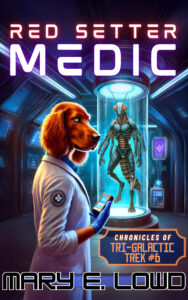 Read more from Red Setter Medic:
[Next]